


Views: 0 Author: Site Editor Publish Time: 2026-07-31 Origin: Site


Every few years, you likely face a highly familiar kitchen dilemma. You stare down at a visibly scratched non-stick pan, weighing whether you should purchase yet another temporary replacement. Or, you eye a professional-looking Stainless Steel Pot but hesitate at the register. You might feel intimidated by memories of cooking eggs that bonded permanently to the metal surface. We often view this choice as a rigid battle between daily convenience and professional durability. However, framing it as a strict competition misses the mark entirely.
You really need cookware tailored to solve specific culinary goals. It should match your personal maintenance tolerance while delivering genuine, long-lasting performance. This guide directly evaluates heat performance, lifespan, health profiles, and daily maintenance realities. We will explore the core mechanical strengths of each material thoroughly. You will learn exactly how to finalize your purchase decision without second-guessing. By the end, you will understand how to build a highly functional, stress-free kitchen setup.
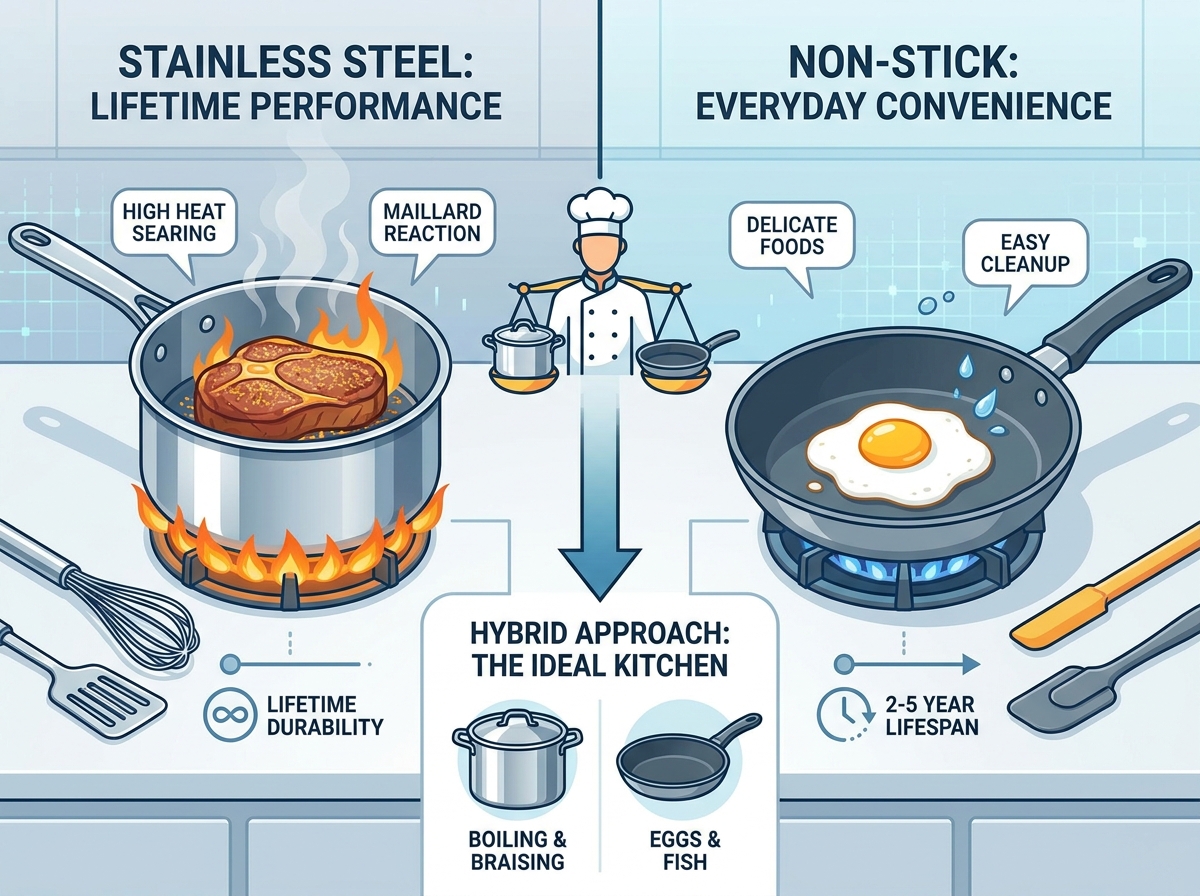
Stainless steel offers lifetime durability, superior browning (Maillard reaction), and handles high heat, but requires proper temperature control to prevent sticking.
Non-stick cookware provides unmatched convenience for delicate foods and easy cleanup but requires gentle handling and replacement every 2–5 years.
Health & Safety: High-quality stainless is non-reactive and stable at all temperatures; non-stick (PTFE or ceramic) is safe at medium heat but degrades under high heat or physical scratching.
The Ideal Kitchen: Most home chefs benefit from a hybrid approach—a large stainless steel pot for heavy-duty boiling and braising, and a dedicated non-stick skillet for eggs and delicate proteins.
Professional chefs rely heavily on specific materials for distinct operational reasons. Let us look closely at how manufacturers construct these tools to understand their performance limits.
Quality matters immensely regarding uncoated cookware. You will often hear the term "cladding" mentioned constantly in professional culinary circles. Cladding refers directly to a multi-ply construction process. Manufacturers bond alternating layers of strong stainless steel around a softer aluminum or copper core. The inner core dictates how quickly the pan responds to temperature changes. It pulls heat rapidly and evenly across the entire base.
Industry standards typically mandate 18/10 stainless steel for exterior cooking layers. This specific alloy contains 18 percent chromium and 10 percent nickel. It provides exceptional rust resistance alongside incredible physical durability. When properly heated, the material retains thermal energy beautifully. This unmatched heat retention creates what chefs call a "fond." A fond consists of caramelized, browned bits left in the pan after searing meat. You can then deglaze these flavorful bits using wine or broth to create rich, restaurant-quality pan sauces.
Coated pans operate on a completely different scientific principle. They utilize specialized chemical or mineral coatings applied directly over a metal base. Traditional coatings use PTFE, which most consumers know commonly as Teflon. Modern alternatives often feature ceramic coatings instead. Ceramic manufacturers use a sol-gel process derived primarily from silica sand.
Both coating styles produce a highly hydrophobic surface. This means they actively repel food particles and water molecules. You can easily cook delicate ingredients using almost zero cooking fat. However, this extreme convenience carries a notable performance tradeoff. The coating inherently acts as a thermal insulator. It physically prevents aggressive heat transfer from reaching your food. Consequently, you will experience much poorer searing and heavily limited browning capabilities.
Cookware Material Construction Breakdown
Material Type | Primary Construction | Heat Retention | Surface Characteristic |
|---|---|---|---|
Fully Clad Uncoated | 18/10 outer layers, aluminum/copper core | Excellent | Reactive to temperature (requires oil/heat) |
Traditional PTFE | Aluminum base, synthetic fluoropolymer coating | Poor to Moderate | Highly hydrophobic (repels water/fat) |
Ceramic (Sol-Gel) | Aluminum base, silica-derived gel coating | Poor to Moderate | Moderately hydrophobic, prone to micro-abrasions |
Different foods demand entirely different thermal environments to cook properly. Matching your specific ingredients to the correct surface guarantees far better results.
Uncoated metal excels aggressively during intense, high-heat applications. You should always reach for it when searing thick steaks. It handles poultry cuts perfectly, allowing the skin to render and crisp properly. It also serves as the ultimate vessel for developing complex, layered sauces.
Furthermore, uncoated metal remains completely non-reactive chemically. This makes it exceptionally safe for preparing highly acidic foods. You can simmer sharp tomato sauces or harsh wine reductions for several hours. The metal will never impart a strange, tinny taste to your finished dish.
Task-specific sizing greatly improves your daily kitchen workflow. Using a Small stainless steel pot works brilliantly for caramelizing diced onions. It also handles reducing small batches of holiday gravy perfectly. Conversely, pulling out a Large stainless steel pot makes much more sense for heavier tasks. You can boil large batches of acidic pasta sauces safely. They easily handle making homemade chicken stocks or cooking heavy weekend braises.
These specialized pans dominate specific morning routines and delicate culinary tasks effortlessly.
Delicate Proteins: Scrambled eggs, flaky white fish fillets, and thin pancakes release effortlessly.
Sticky Starches: Reheating leftover sticky rice becomes remarkably easy. The surface also handles sugary marinades prone to severe burning.
Low-Heat Convenience: They shine brightly during quick weekday meals. Rapid cleanup serves as the primary success metric here.
Evaluating cookware requires looking far past the initial unboxing phase. You must consider long-term material viability and safety profiles highly objectively.
Uncoated metal truly offers a genuine "buy it for life" reality. A fully clad piece can easily outlive its original owner. It routinely survives accidental drops, massive thermal shocks, and aggressive metal scraping. Contrast this directly against coated alternatives. Even premium coated options face an inevitable, unavoidable degradation cycle. Most culinary experts agree they require complete replacement every two to five years. The surface simply loses its hydrophobic properties over time due to microscopic wear.
Consumers frequently express highly valid concerns across online cooking forums. Many worry deeply about PTFE degradation at extreme temperatures. When heated above 500°F (260°C), traditional synthetic coatings begin breaking down. This breakdown releases toxic fumes known to cause "polymer fume fever."
Modern options proudly advertise a strict PFOA-free construction. This thankfully eliminates one harmful manufacturing chemical entirely. However, peeling coatings still present genuine ingestion concerns. While ingested flakes might pass through your digestive system safely, the functional loss remains permanent. The pan becomes practically useless once the surface flakes away.
Uncoated metal stands proudly as the biologically inert alternative. It remains completely stable at incredibly high temperatures. It never releases toxic fumes, peels, or flakes foreign material into your evening meal.
Every professional tool requires specific maintenance to perform correctly. Understanding these baseline rules prevents daily frustration and ruined dinners.
Coated surfaces demand strict, non-negotiable handling rules to survive daily use.
No metal utensils: Never use metal forks, whisks, or spatulas. They create micro-scratches instantly.
No dishwashers: Avoid the dishwasher entirely, despite optimistic manufacturer marketing claims. Harsh detergents eat away the coating.
No abrasive sponges: Never scrub the surface using steel wool or heavy-duty scouring pads.
No aerosol sprays: Do not apply aerosol cooking sprays. They contain soy lecithin, which bakes into a sticky residue.
We must clearly acknowledge the learning curve associated here. You absolutely must understand the Leidenfrost effect to succeed. This technique requires pre-heating the dry pan thoroughly before adding oil. You wait until dropped beads of water dance rapidly across the hot surface. This exact temperature creates a naturally frictionless barrier between the metal and your food.
Cleanup transparency is equally important to discuss. These pieces are genuinely dishwasher safe for daily sanitization. However, removing stubborn polymerized oil requires specific, targeted interventions. You might need specialized cleaning agents like Bar Keepers Friend. The oxalic acid inside breaks down burnt carbon bonds easily. Alternatively, boiling baking soda and white vinegar removes stuck bits completely effortlessly.
Navigating the crowded retail landscape feels overwhelming without clear selection criteria. Use these strict guidelines to separate quality culinary tools from empty marketing hype.
Always opt for heavy, hard-anodized aluminum bases. This hardened material resists high-heat warping significantly better than thin, stamped aluminum. Keep your shopping expectations grounded in reality. Never overspend excessively on a pan destined to wear out quickly. You will need to replace it eventually, regardless of the premium brand name.
When hunting for the Best stainless steel pot, look closely at the base construction. You want "fully clad" construction universally. This means tri-ply or 5-ply metallic layers run all the way up the sides. Avoid cheaper "disc-bottom" pans where heat distribution happens only directly underneath the food.
Check the handle attachments very carefully. You want securely riveted, ergonomic handles for maximum lifting security. Ensure the lids fit tightly to trap moisture during braising sessions. Finally, assess the physical weight in your hands. It should feel pleasantly substantial but remain manageable for daily pouring and lifting tasks.
The final verdict depends entirely on your daily cooking habits and patience levels. Choose coated cookware explicitly for low-effort, delicate tasks. It reigns supreme when rapid convenience and zero sticking are paramount. Invest in uncoated metal for high-performance, high-heat cooking. It delivers permanent durability alongside professional-level browning capabilities.
For your actionable next steps, we strongly recommend conducting a quick kitchen audit. Review what ingredients you cook most frequently during the average week. Consider investing heavily in a primary, high-quality, uncoated piece. A versatile sauté pan or large pot serves as a perfect starting point. You can then strategically keep an inexpensive coated skillet explicitly reserved for your delicate morning breakfast duties.
A: Yes, you can temporarily create a naturally non-stick surface using proper heat management. Pre-heat the dry pan until water droplets dance rapidly across the surface (the Leidenfrost effect). Once reached, wipe away the water, add your cooking oil, and let it shimmer before adding food.
A: You should replace it immediately. While the FDA states that accidentally ingesting small flakes of modern PTFE is generally not a severe health hazard, the pan loses its core functionality. Deep scratches also expose the underlying aluminum core to acidic foods, altering food taste.
A: This happens due to common temperature errors. Either you added food before the pan reached the correct high temperature, or you attempted to move the food too early. Proteins naturally stick upon initial contact. They will release themselves automatically once a proper caramelized crust forms.
A: Both remain perfectly safe under normal cooking conditions. Ceramic pans avoid synthetic PTFE chemicals entirely, offering peace of mind for some users. However, uncoated metal possesses a much longer track record of total chemical stability. It never degrades or releases any microscopic layers into your meals.