


Views: 0 Author: Site Editor Publish Time: 2026-07-31 Origin: Site


Upgrading your kitchen arsenal often leads directly to purchasing new equipment. You quickly face confusing manufacturing jargon like cladding, ply counts, and metallurgical grades. High upfront costs make the decision even more stressful for home cooks. A poorly constructed vessel results in warped bases, frustrating hot spots, and scorched food. You must understand there is no single flawless piece of cookware available. The optimal choice depends entirely on your specific heat source, typical daily cooking volume, and personal tolerance for physical weight. Professional kitchens prioritize rugged durability and high thermal mass over pure visual aesthetics. They need gear built to survive constant daily abuse. We created this comprehensive guide to clear up the industry confusion. We provide a rigorous, evidence-based framework for evaluating core manufacturing specifications. You will learn exactly what matters most when examining a Stainless Steel Pot. This ensures a high-ROI, lifelong cookware investment.
Material Grade Matters: Look for 18/10 stainless steel for the cooking surface to prevent pitting and rust, and 18/0 for the exterior if using an induction cooktop.
Cladding Over Disc Bases: Fully clad construction (aluminum or copper core running up the sides) outperforms bottom-disc designs in heat distribution and prevents scorching at the edges.
Ply Count Realities: 3-ply is the industry standard for responsiveness; 5-ply offers better heat retention but adds significant weight and cost with diminishing returns for everyday cooks.
Ergonomics Dictate Use: A poorly angled handle or straight lip will ruin the experience of an otherwise high-quality pot. Flared rims and riveted, stay-cool handles are non-negotiable for heavy use.
Let us break down the confusing numbers stamped on your cookware. You often see 18/10, 18/8, or 18/0 prominently displayed on the bottom. These numbers represent the exact chromium-to-nickel ratio formulated in the alloy. The 18% chromium provides the essential baseline rust resistance. It forms a microscopic passive layer preventing oxidation. The 10% (or 8%) nickel adds a brilliant polished finish. More importantly, it offers vital structural resistance to harsh food acids. Simmering acidic ingredients like crushed tomatoes or wine-based sauces demands high nickel content to prevent tiny black pinholes known as pitting. We must carefully distinguish between interior and exterior metallurgical requirements.
Cooking Surface: It absolutely must be 18/10 (commonly known as 304 grade in industrial terms). This specific alloy ensures maximum food safety. It prevents metallic leaching into your meals.
Exterior Base: It must utilize 18/0 (400 grade) magnetic steel. Manufacturers exclude nickel here intentionally. Without this specific magnetic layer, the cookware will completely fail to operate on modern induction cooktops.
Do not fall for the pervasive "stain-free" myth. Let us set transparent, realistic expectations right now. Even top-tier 18/10 alloys will develop hazy protein films over time. You might also notice distinct rainbow-colored heat tints after boiling starchy water. These cosmetic surface changes require specialized acidic cleaning products like Barkeepers Friend. They represent normal chemical reactions. They do not indicate a structural manufacturing flaw.
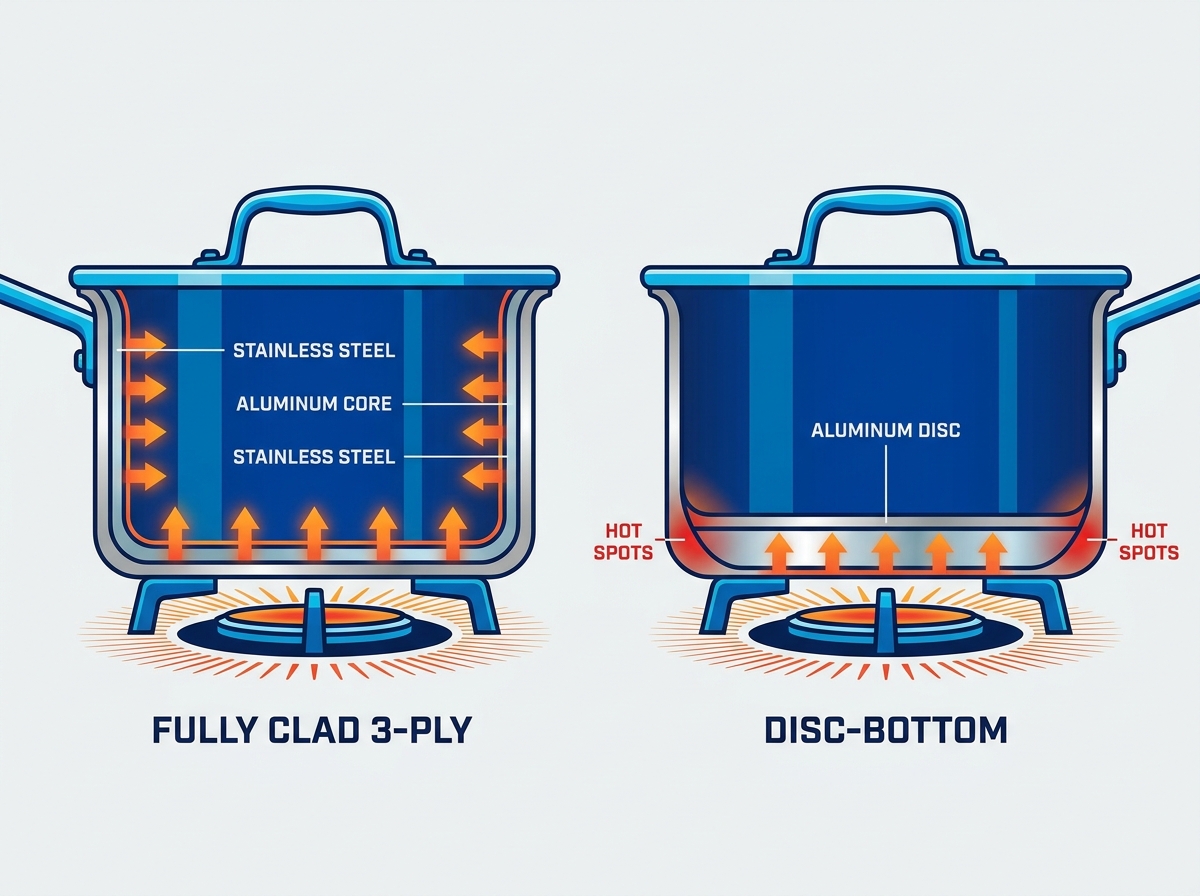
Steel alone conducts heat exceptionally poorly. Manufacturers solve this glaring thermal issue by bonding the steel to highly conductive metals. First, consider fully clad versus traditional disc-bottomed designs. Disc-bottom options remain significantly cheaper to produce. Manufacturers simply weld a thick conductive aluminum disc only to the flat base. This creates a severe operational flaw. You get intense heat-ring scorching right where the disc ends. Fully clad construction fixes this localized burning entirely. The conductive core runs continuously all the way up the vertical walls. Heat travels evenly across the entire internal surface area. This feature proves absolutely essential for thick purees or delicate cheese sauces. It actively prevents aggressive side-wall scorching during heavy stovetop reductions. Next, evaluate the various ply counts heavily marketed today. We regularly see 3-ply, 5-ply, and even extreme 7-ply options.
3-Ply (Tri-Ply): This remains the undeniable industry standard. It offers the ideal balance of overall weight, quick thermal responsiveness, and an approachable price point.
5-Ply: This design features alternating inner layers of steel and conductive aluminum. It naturally heats up slower. However, it holds its temperature incredibly well. Adding massive amounts of cold ingredients will not drop the cooking surface temperature drastically.
The "Over-Engineering" Trap: 7-ply configurations often add unnecessary bulk without delivering measurable thermal benefits. You should always focus on the total thickness of the conductive core instead of the sheer layer count.
Finally, core material dictates daily performance. Aluminum acts as the gold standard for home use. It proves highly effective, lightweight, and affordable. Copper reacts much faster to rapid burner temperature changes. Serious chefs love copper for delicate sugar work. However, thick copper cores increase the retail price exponentially.
Construction Type | Wall Heat Distribution | Thermal Responsiveness | Ideal Cooking Application |
|---|---|---|---|
Disc-Bottom (Aluminum) | Poor (Base only) | Slow | Boiling pasta water, thin broths |
3-Ply Fully Clad | Excellent | Fast | Everyday batch cooking, pan sauces |
5-Ply Fully Clad | Excellent | Moderate | Searing heavy meats, heat retention |
Copper Core Clad | Superior | Immediate | Precision temperature control tasks |
Choosing the correct capacity prevents daily kitchen frustration. You need specific vessel sizes optimized for specific culinary tasks. Let us start by analyzing the Small stainless steel pot (1.5 to 3 Quarts). These compact vessels shine when cooking morning oatmeal, reducing rich sauces, or melting butter quickly. They also handle small pasta portions perfectly. Balance remains the most critical physical specification here. A tiny vessel equipped with an overly heavy, long handle will easily tip over on raised gas grates. This creates an immediate physical hazard in your kitchen. Always look for a wider base to ensure strict stovetop stability. A wider base also provides greater surface area, which helps evaporate excess liquids much faster during sauce reductions. Moving up the scale, mid-size options (4 to 6 Quarts) handle the daily heavy lifting. They work best for hearty soups, rapidly blanching green vegetables, and everyday batch cooking. As overall capacity increases, the total physical weight goes up significantly. Helper handles become absolutely necessary at this specific stage. You certainly do not want to lift five quarts of boiling liquid single-handedly using just one wrist. Finally, consider the utility of a Large stainless steel pot (8 to 12+ Quarts). These massive vessels excel at extracting bone broths, executing large-scale boiling, and seasonal canning. Interestingly, cheaper disc-bottoms are occasionally acceptable here. If you strictly boil water for pasta, the moving liquid inherently prevents localized side-scorching. However, for thick, viscous recipes like heavy chilis or hearty stews, full continuous cladding still reigns supreme.
A premium cooking vessel should feel exactly like a natural extension of your hand. Minor hardware flaws routinely ruin the cooking experience of an otherwise stellar pan. Handle attachment methods spark endless debate among professionals. You generally must choose between traditional rivets and modern welds.
Rivets: They stand as the undisputed industry standard. Manufacturers stamp them under immense pressure. They are extremely durable and rarely fail. However, they can trap stubborn food debris inside the cooking vessel. You must scrub them carefully using a stiff brush.
Welds: They present a completely smooth, easy-to-clean interior surface. Unfortunately, lower-quality welds can snap abruptly under extremely heavy liquid loads. High-volume professional kitchens usually avoid them entirely for strict safety reasons.
You must also closely consider handle thermal dynamics. Smart manufacturers employ specific engineering tricks to prevent serious burns. Look for distinct "V-shaped" cutouts or hollow handle forks. This intelligent design physically disrupts heat transfer right where the solid handle meets the hot vessel. Less mass at the connection point means less heat travels into your hand. It effectively keeps the long handle cool during prolonged stovetop use. Heavy cast-iron handles, by contrast, will absorb heat rapidly and require thick oven mitts. Do not overlook the immense practical importance of flared rims. Straight vertical lips cause terrible, frustrating messes. Hot liquids run directly down the exterior side during transfer. A rolled or flared lip ensures a perfectly clean, drip-free pour every single time. Finally, examine the specific lid specifications closely.
Solid Steel Lids: They will never shatter when dropped. They remain entirely oven-safe up to extremely high broiler temperatures.
Tempered Glass Lids: They allow constant visual monitoring of your simmering food. However, they generally have much lower oven-safe temperature limits. They can also trap stubborn moisture and gross grease within their metal rim bindings.
Evaluating endless market options requires a highly practical approach. Finding the Best stainless steel pot means matching the technical specs directly to your actual daily habits. First, you must match the total vessel weight to your personal physical capability. High-quality clad cookware is inherently heavy by design. You must constantly factor in the empty weight of the pan plus the actual dense liquid inside. One gallon of water weighs over eight pounds. If the empty pan heavily strains your wrists in the store, it will become dangerous when full. Second, practice strict stovetop matching. Ensure the flat base diameter closely matches your primary burner size. A base too small wastes expensive heat energy around the sides. A base too large creates annoying, sluggish cold spots at the outer edges. Let us discuss realistic budgeting expectations:
Premium Tier ($150+): You get absolutely flawless mirror finishing, highly optimized ergonomics, and extremely reliable American or European manufacturing. The core aluminum layers are typically much thicker here.
Value Tier ($50–$90): You receive very good 3-ply thermal performance. However, you might have to accept minor compromises in handle comfort, weight balance, or overall visual aesthetics.
Watch out for immediate manufacturing red flags. Avoid buying anything featuring exposed raw aluminum at the upper rims. Harsh modern dishwashers will degrade this soft metal quickly, leaving sharp edges. Also, firmly reject ultra-thin side walls. You can test this by firmly squeezing the top rim. Thin walls will warp permanently under high stovetop heat.
The ideal cooking vessel perfectly balances high-grade 18/10 interior surfaces, fully clad conductive aluminum cores, and high-stability ergonomic handles. You want a reliable tool intentionally built for rigorous daily utility rather than mere visual appeal on a shelf. Do not overpay for excessive ply counts if a well-constructed 3-ply model completely meets your daily thermal demands. Take these immediate next steps to narrow your search:
Measure your primary stovetop burners to definitively establish your maximum allowable base diameter limit.
Assess your current weekly menu to decide between rapid boiling needs or delicate pan sauces. This dictates whether cheap disc bases suffice or if you require full cladding.
Visit a local retail store to physically lift heavy clad pans. This helps you safely gauge your personal weight tolerance before ordering heavier 5-ply options online.
A: They only work if the exterior layer consists of magnetic steel, typically graded as 18/0. Always look for the coiled induction-compatible symbol engraved on the bottom. If you shop in person, bring a simple refrigerator magnet. If the magnet sticks firmly to the base, the vessel will successfully function on any induction cooktop.
A: Sticking happens when proteins chemically bond to cold metal. You can easily prevent this by properly preheating the vessel before adding any cooking oil. Utilize the Leidenfrost effect to gauge readiness. Drop a tiny amount of water into the pan; if the droplets dance and skitter across the surface without evaporating immediately, it is fully ready.
A: While manufacturers often label them dishwasher safe, harsh machine detergents can severely dull the polished finish over time. Furthermore, cookware featuring exposed aluminum cores at the rim can experience destructive galvanic corrosion if repeatedly machine-washed. We highly recommend simple hand washing with mild soap and warm water to ensure maximum longevity.