


Views: 0 Author: Site Editor Publish Time: 2026-07-31 Origin: Site


High-volume, high-heat culinary environments present harsh realities for daily cooking. Searing burner temperatures, relentless physical impact, and rapid thermal shifts quickly test the limits of kitchen equipment. Equipment failure directly damages food consistency and unnecessarily inflates operational costs. Unfortunately, many buyers struggle to distinguish between entry-level single-layer metal pans and true heavy-duty, multi-clad professional cookware. This knowledge gap often leads to scorched sauces and frequent replacement cycles.
We built this article to offer an evidence-based framework for evaluating and selecting superior equipment. You will learn the exact performance differences between various builds and alloys. We will also reveal how to master temperature control to prevent food sticking. Finally, we will show you how to maximize the lifespan of a professional-grade Stainless Steel Pot in your busy kitchen.
Heavy-duty, fully clad stainless steel eliminates hot spots, prevents warping under thermal shock, and offers lifelong durability without degrading toxic coatings.
The material’s unique surface structure is critical for proper fond development and the Maillard reaction, directly elevating flavor profiles.
Strategic selection based on ply-count (3-ply vs. 5-ply), core material, and ergonomic design is more cost-effective than buying pre-packaged consumer sets.
Mastering temperature control (pre-heating and the Leidenfrost effect) completely negates the common misconception that stainless steel is prone to sticking.
Cooks face severe challenges when they rely on substandard equipment. In a professional kitchen, reliability means everything. You cannot afford tools that fail during a dinner rush. Let us examine the sharp contrast between professional and standard options.
Cheap pots hide their true expenses well. At first glance, a budget pan saves money. However, these savings vanish within weeks of heavy use. Thin bases warp under high heat. A warped pan spins endlessly on flat ranges. This poor contact destroys heat distribution.
Uneven heat creates unpredictable cooking environments. Your delicate sauces scorch in one corner while remaining lukewarm in another. These hidden costs multiply fast. Consider the following common issues caused by cheap cookware:
Warped bases: They wobble on induction plates, causing error codes and heating failures.
Scorched ingredients: Hot spots burn dairy and sugar, forcing you to throw out expensive ingredients.
Frequent replacement: Weak handles break and thin metals dent. You buy the same cheap pan three times a year.
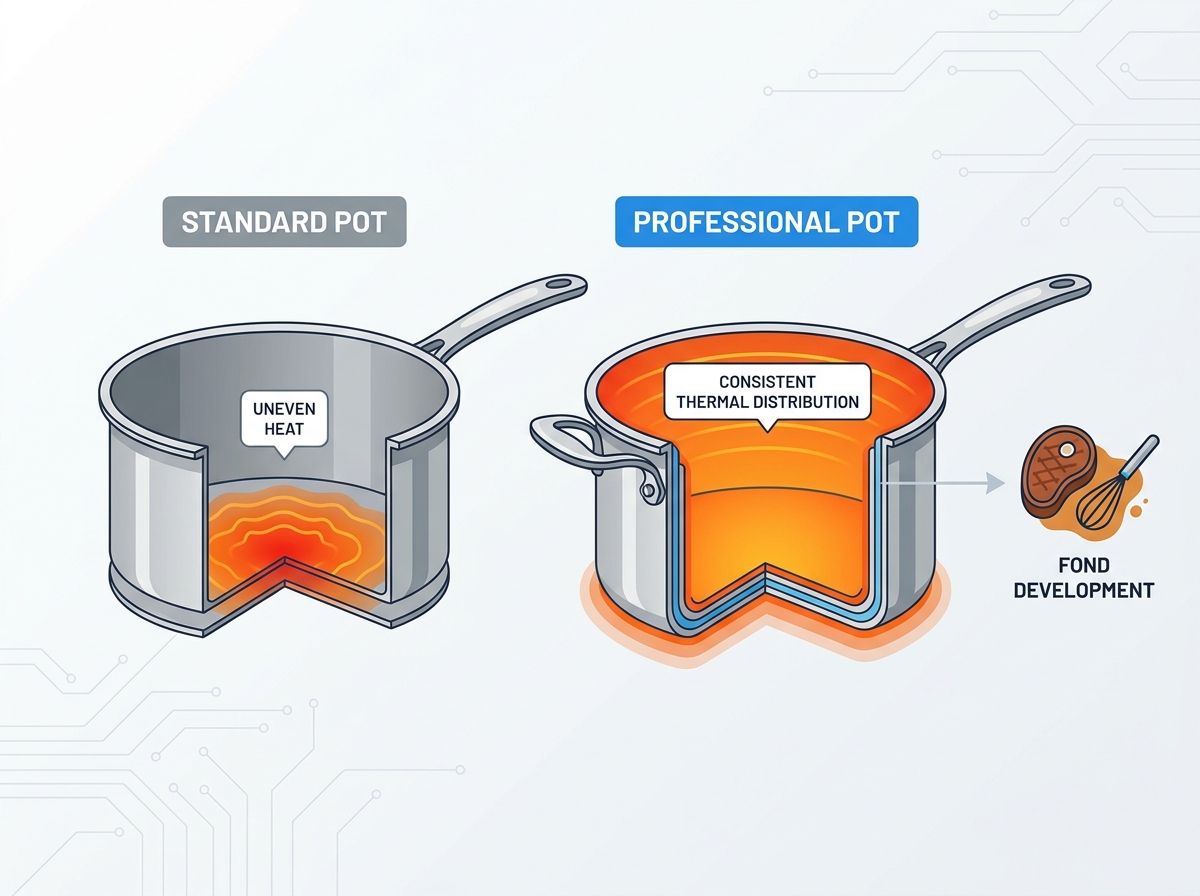
What exactly makes a pan professional-grade? The secret lies in construction. True professional pans utilize fully clad, multi-ply designs. Manufacturers bond different metals together to create a single, unified sheet. They press this sheet into the shape of the pot.
Standard pans rely on inferior disc-bottom designs. A factory simply glues an aluminum plate to the base of a thin steel pot. The sides remain single-layer steel. Heat only transfers across the very bottom. The sides stay cold. Fully clad construction ensures the entire vessel heats evenly from the base to the rim.
Stainless steel resists corrosion brilliantly. It is highly durable. However, it conducts heat poorly on its own. Engineers solve this by trapping highly conductive metals inside the steel.
They sandwich an aluminum or copper core between layers of steel. This core acts as a thermal highway. It grabs heat from the burner and pushes it up the walls. This creates edge-to-edge temperature consistency. You get the rugged exterior of steel alongside the rapid heat transfer of aluminum. It provides the perfect balance for intense cooking.
Upgrading your equipment unlocks new culinary techniques. High-quality pans actively improve the flavor of your food. They provide unique benefits you cannot get from non-stick or aluminum alternatives.
Chefs love stainless steel because proteins adhere to it slightly. This adhesion is not a flaw. It is a vital culinary mechanic. When you sear meat, small bits stick to the pan. They caramelize and turn brown. We call these browned bits "fond."
Fond forms the backbone of incredible pan sauces. You cannot create proper fond in a non-stick skillet. The slick surface prevents it. To harvest this flavor, you pour a cold liquid like wine or stock into the hot pan. The liquid boils instantly. You scrape the bottom with a wooden spoon. This technique, called deglazing, lifts the rich flavors directly into your sauce.
Certain metals react badly to acidic foods. Carbon steel, cast iron, and aluminum all leach metallic flavors when exposed to acid. If you simmer a tomato sauce in cast iron for three hours, it tastes like a tin can. The metal actually dissolves into your food.
Stainless steel possesses non-reactive purity. It remains completely inert. You can cook heavily acidic ingredients without worry. Tomatoes, wine, vinegar, and citrus will never compromise the metal. Your flavors remain bright, pure, and exactly as you intended.
Professional environments destroy fragile gear. Toxic non-stick coatings scratch easily and flake into food. You must replace them constantly. Heavy-duty stainless steel defies this kind of wear.
It withstands metal whisks, heavy spatulas, and aggressive tongs. It maintains its structural integrity under intense broiler heat. Furthermore, it easily survives the commercial dish pit. Harsh abrasives and heavy-duty caustic detergents will not strip the finish. You invest once, and it serves you for decades.
You do not need a massive 15-piece set. Smart cooks build a targeted arsenal. They select specific sizes for specific tasks. Let us look at the most essential dimensions.
A smaller vessel typically falls into the 1-to-3 quart range. We often call them saucepans. They handle tasks requiring intense precision. They are nimble and highly responsive to temperature changes.
You use them for tight, controlled work. They excel at precise liquid reductions. They are perfect for mounting butter into a sauce off the heat. You will also use them for melting chocolate and crafting small-batch sugar syrups.
When evaluating a Small stainless steel pot, look for flared rims. Flared rims allow you to pour hot liquids without dripping them down the exterior walls. You also need a substantial, heavy base. A thick base prevents you from accidentally scorching delicate dairy or sugar during sensitive reductions.
You must balance your small tools with heavy lifters. This category covers the 8-to-20+ quart range. It includes massive stockpots and wide rondeaus. They handle high-volume batch cooking.
Their primary use cases involve massive volumes of water. You use them for extracting bone stocks over a 12-hour simmer. They handle bulk boiling for pasta during a busy service. Wide versions excel at large-scale braising of heavy meat cuts.
When selecting a Large stainless steel pot, prioritize structural integrity. It must resist denting when fully loaded and banged against a sink. Look closely at the handles. Securely riveted loop handles are absolutely mandatory. A spot-welded handle can snap off when you are carrying 20 quarts of boiling stock. Finally, ensure the bottom is perfectly flat to guarantee full induction compatibility.
Marketing hype confuses many buyers. Brands throw around technical jargon to justify high prices. We must strip away the noise. You need to know exactly which specifications impact daily performance.
You will constantly see the terms 3-ply and 5-ply. "Ply" simply means layers. A 3-ply pan has three layers: steel, aluminum, and steel. A 5-ply pan typically features steel, aluminum, a thicker metal core, more aluminum, and steel.
Is more always better? Not necessarily. Let us look at the objective differences. 5-ply construction retains heat remarkably well. When you drop a cold steak into it, the pan stays hot. However, it takes longer to heat up and responds slowly when you turn the burner down.
Alternatively, 3-ply is lighter. It responds instantly to temperature adjustments. If a sauce is boiling over, turning down the heat on a 3-ply pan stops the boil immediately. We recommend choosing based on application. Use 5-ply for searing and heavy roasting. Use 3-ply for delicate sauces and sautéing.
Performance Comparison Chart: 3-Ply vs. 5-Ply | ||
Feature | 3-Ply Construction | 5-Ply Construction |
|---|---|---|
Heat Responsiveness | Fast. Adjusts quickly to burner changes. | Slow. Holds heat even after burner is off. |
Weight | Lighter, easier to toss and maneuver. | Heavier, requires more effort to lift. |
Best Culinary Use | Sauces, sautéing, boiling vegetables. | Deep searing, braising, maintaining simmers. |
Price Range | Generally more affordable. | Premium pricing. |
The numbers 18/10 and 18/0 refer to the metal alloy mixture. The first number represents chromium. The second number represents nickel. Therefore, 18/10 contains 18% chromium and 10% nickel.
You must understand these American Iron and Steel Institute (AISI) grading basics. Nickel gives the metal its bright shine. More importantly, nickel provides extreme rust and corrosion resistance. The cooking surface of your pan should always be 18/10. It touches the acidic food and needs maximum protection.
However, high nickel content removes magnetic properties. Induction burners require magnetism to work. Manufacturers solve this brilliantly. They use 18/0 steel for the exterior base. It has zero nickel, making it highly magnetic. This dual-alloy strategy gives you the Best stainless steel pot possible: safe inside, induction-ready outside.
Alloy Grade | Chromium % | Nickel % | Primary Function & Location |
|---|---|---|---|
18/10 (304 Grade) | 18% | 10% | Interior cooking surface. Maximum rust/acid resistance. |
18/0 (400 Series) | 18% | 0% | Exterior bottom. Ensures magnetic induction compatibility. |
Chefs hold handles for hours. Poor handle geometry causes blisters and wrist strain. Look for stay-cool hollow designs. Solid metal handles transfer heat rapidly, burning your hand. Hollow handles trap air, drastically slowing heat transfer.
Pay attention to bifurcated yokes. The "yoke" is where the handle meets the pan. A bifurcated yoke splits into a V-shape right before it touches the pot. This split creates a massive air gap, preventing heat from traveling up the handle. Finally, inspect the rivets. Avoid welded joints. Look for thick, protruding steel rivets. They ensure the handle will never separate from the vessel under load.
We must address the biggest barrier to adoption. Many cooks avoid these pans because they fear sticking. Let us demystify the physics behind this issue and fix it forever.
When you look at cold steel under a microscope, it is not perfectly smooth. It features thousands of tiny, jagged pores. When you add cold chicken to a cold pan and turn on the heat, the meat sinks into these pores. As the metal expands from the heat, it clamps down on the protein. It acts like microscopic teeth holding your food hostage.
You can easily defeat this physical reaction using temperature. You must pre-heat the dry pan before adding oil. This process expands the metal, closing those microscopic pores completely. We use the "Water Drop Test" to verify readiness.
This test relies on the Leidenfrost effect. Here are the exact operational steps to achieve a naturally non-stick surface:
Place the completely dry, clean pan on medium heat.
Wait approximately two to three minutes.
Flick a few tiny drops of water onto the surface.
Observe the reaction. If the water instantly sizzles and evaporates, the pan is too cold.
Wait another 30 seconds and test again. If the water drops form tight beads and dance rapidly across the surface like mercury, the pan is ready.
This dancing effect proves the pan is hot enough. The water vaporizes instantly on contact, creating a cushion of steam. Your pan is now virtually non-stick.
Once you see the dancing water, wipe the pan dry. Now, pour in your cooking fat. This leads to the golden rule of kitchens: "Hot pan, cold oil." Swirl the oil to coat the bottom. It should shimmer instantly.
Add your protein. It will sizzle aggressively. The most crucial step follows: leave it alone. Do not poke, prod, or attempt to flip it immediately. The protein needs time to sear. It will naturally release from the metal once a proper crust forms. If you feel resistance when trying to flip a steak, it simply needs another minute.
Investing in heavy-duty, fully clad equipment dramatically improves your kitchen operations. The return on investment becomes obvious within the first year. You eliminate the constant replacement costs associated with cheap, warped pans. You gain edge-to-edge heat consistency, reducing food waste and improving flavor.
Resist the urge to buy massive, redundant cookware sets. Most of those pieces simply gather dust. Instead, practice strict budget efficiency. Shortlist two or three versatile sizes based entirely on your actual daily menu requirements. Focus on high-quality 3-ply or 5-ply construction with robust rivet geometry.
Start your upgrade process today. Walk into your kitchen and audit your current cookware lineup. Check for wobbly bases on flat counters. Inspect non-stick skillets for degraded or peeling coatings. Throw away the damaged gear and upgrade your foundational pieces first.
A: Food sticks because cold steel has microscopic pores that grab proteins as the metal heats up. Prevent this by pre-heating the dry pan until it passes the water drop test (the Leidenfrost effect). Add oil only after the pan is hot. Let the food sear undisturbed until it releases naturally.
A: It depends on your task. 5-ply is heavier and holds heat better, making it ideal for deep searing and maintaining steady simmers. 3-ply is lighter and highly responsive to quick temperature changes, making it superior for delicate sauces and fast sautéing.
A: Avoid harsh steel wool. Use a specialized powdered cleanser containing oxalic acid, like Bar Keepers Friend. Create a paste with water, apply it to the stains, let it sit for a minute, and scrub gently with a non-abrasive sponge. The acid easily dissolves heat tints and mineral spots.
A: Yes, provided they are built correctly. High-quality pans use 18/0 grade steel on the exterior base. This specific alloy lacks nickel, which makes it highly magnetic and perfectly suited for commercial induction ranges. Always check for a flat, unwarped bottom to ensure full sensor contact.
A: Absolutely. True professional-grade steel easily withstands regular use with metal tools. While heavy scraping may cause superficial, cosmetic scratches over time, these minor marks will not impact the pan's cooking performance, structural integrity, or safety.