


Views: 0 Author: Site Editor Publish Time: 2026-10-22 Origin: Site


Selecting the wrong transport equipment leads to premature wear, workflow bottlenecks, and compromised sanitation. You might assume any wheeled platform gets the job done easily. However, making an incorrect choice actively disrupts daily operations and frustrates your staff. Buyers often confuse dining carts and utility carts. While both move items from point A to point B, their engineering, load capacities, and compliance standards differ entirely. Misinterpreting these differences can result in health code violations or damaged brand perception. This guide delivers an objective, side-by-side comparison of these two essential transport tools. We will help you match the right equipment to your specific workflow, payload requirements, and compliance needs. By the end, you will understand exactly which option safeguards your operational efficiency.
Stainless steel dining carts prioritize sanitation, aesthetics, and NSF compliance, making them ideal for front-of-house serving, bussing, and food prep environments.
Utility carts prioritize heavy payload capacity, impact resistance, and durability, suited for back-of-house, industrial, or high-volume transport.
The deciding factors ultimately come down to load rating requirements, visual presentation standards, and chemical/moisture exposure.
Selecting the wrong caster type for your flooring will negate the benefits of either cart type.
You must first identify where your cart spends 80% of its lifecycle. Carts operating in plain sight require distinct design tolerances. Customers judge your brand based on everything they see in the dining area. Therefore, front-of-house equipment demands sleek lines and spotless surfaces. Conversely, carts hidden in stockrooms or loading docks face different realities. These environments prioritize raw strength and impact resistance over visual appeal.
Avoid purchasing one cart type and expecting it to do both jobs seamlessly. We call this the "hybrid" myth. Using a heavy-duty polymer utility cart in a high-end dining room damages brand perception instantly. It looks out of place next to linen tablecloths and fine tableware. On the other hand, using a refined dining cart for hauling 500 lbs of raw ingredients causes structural warping. It simply lacks the reinforcement needed for extreme warehouse abuse.
A successful purchase minimizes replacement cycles and reduces physical strain on your staff. It also maintains strict compliance with local health codes. When you frame the decision around these operational realities, the right choice becomes obvious.
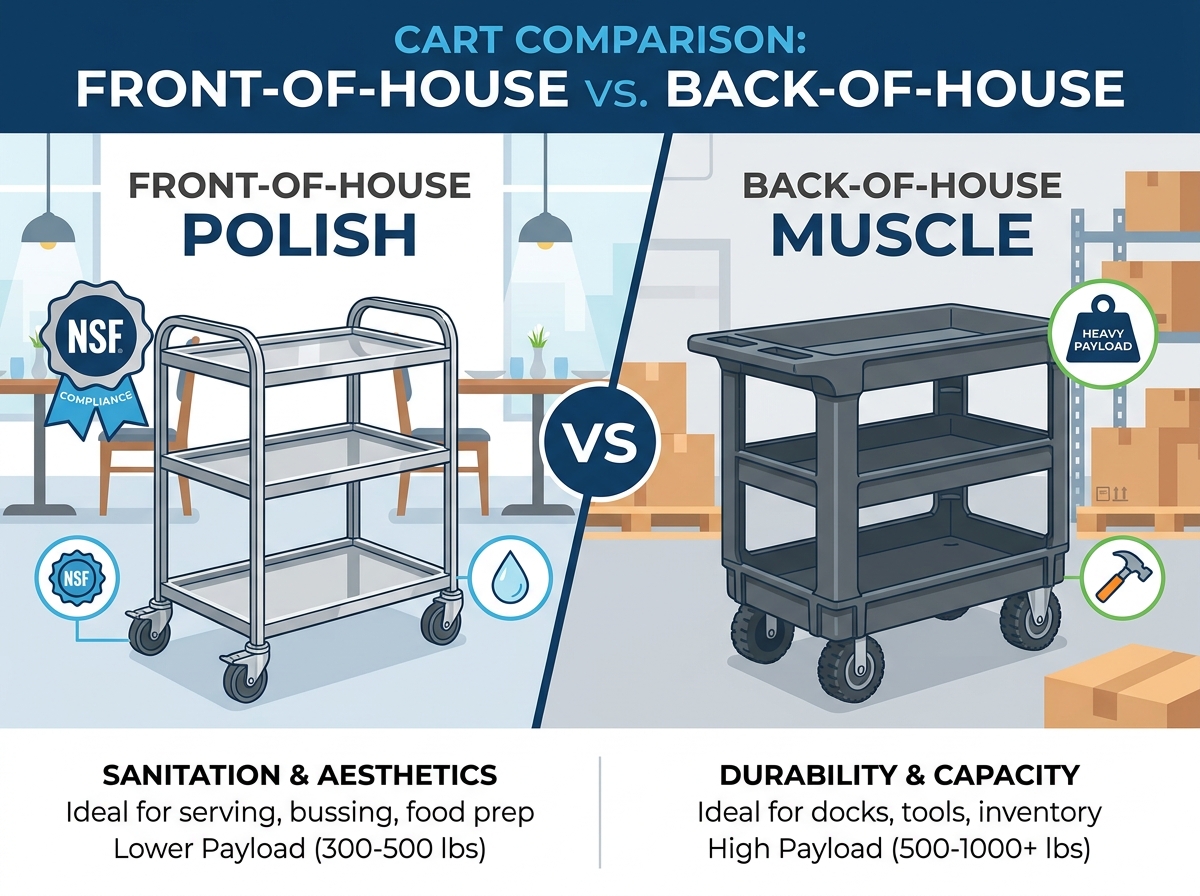
Manufacturers build this category primarily from 300-series or 400-series stainless steel. These units feature smooth welds, sound-deadening materials under the shelves, and easy-to-sanitize surfaces. Integrating a premium Stainless Steel Dinning Cart elevates the visual appeal of any professional serving space. The design intentionally eliminates crevices where food particles usually hide.
This equipment category offers several core advantages for specific industries:
Sanitation: Non-porous surfaces actively resist bacterial growth. They withstand harsh chemical sanitizers daily without degrading.
Aesthetics: These units deliver a professional, sleek appearance. Managers find them perfectly acceptable for tableside service or open-kitchen displays.
Rust Resistance: High-grade alloys provide excellent resistance to moisture and food acids. Type 304 steel excels particularly in wet environments.
Despite these benefits, you must acknowledge a few known limitations. They generally offer a lower total weight capacity compared to industrial utility models. Most handle 300 to 500 lbs safely. Exceeding this limit compromises the structural integrity. Furthermore, they remain susceptible to cosmetic denting. Striking them against heavy machinery or heavy metal doors leaves permanent marks.
These units perform best in hospitals, catering operations, and restaurant front-of-house settings. Bakeries and cleanroom environments also rely heavily on their sanitary properties.
We define this category as heavy-duty transport units built for pure endurance. Manufacturers typically construct them from high-density polyethylene (HDPE), structural foam, or heavy-gauge powder-coated steel. They often feature deep shelf lips to prevent items from sliding off during transit. These carts emphasize function and durability above all visual considerations.
Utility carts bring three core advantages to your operation:
Payload Capacity: They can often safely transport 500 to 1,000+ lbs. The shelves will not bow or buckle under extreme weight.
Impact Resistance: Polymer variants absorb collisions effortlessly. They will not dent, chip, or rust when subjected to warehouse abuse.
Cost-Efficiency: These units typically offer a lower initial procurement cost per pound of carrying capacity.
However, you must consider their known limitations before outfitting your entire facility. Their bulky profiles make maneuvering in tight dining spaces incredibly difficult. They often bump into chairs or block narrow aisles. More importantly, plastic shelves develop deep scratches over time. These micro-abrasions trap bacteria permanently, making the surface unsuitable for direct food contact.
We highly recommend these units for loading docks, dish pits, and tool transport. Janitorial duties and heavy inventory stocking also perfectly match their rugged profile.
You must evaluate the per-shelf capacity versus the total cart capacity. A cart might advertise a 600 lb total limit, but each shelf only supports 200 lbs. Overloading the top tier causes dangerous top-heaviness. Look for reinforced gussets in metal designs. These small triangular metal pieces add immense stability to the upright posts. For polymer versions, look for molded-in reinforcements and honeycomb patterns under the shelves.
Assess your need for NSF (National Sanitation Foundation) certification carefully. Health inspectors look for this specific mark during surprise visits. Metal dining options generally pass these inspections effortlessly due to their crevice-free designs. Inspectors appreciate the smooth, non-porous nature of the material. Polymer units struggle here if they sustain deep cuts or if structural seams harbor moisture.
Caster selection dictates daily usability. Examine the caster materials closely before making a purchase. Choose TPR (Thermoplastic Rubber) wheels for quiet dining rooms. They glide silently over tile and hardwood. Choose Polyurethane wheels for heavy loads on concrete surfaces. They resist flat-spotting under extreme weight. Additionally, check for swivel-lock mechanisms. Braking reliability prevents fully loaded carts from rolling down inclines.
Metal options require a higher upfront investment. However, they offer a near-infinite lifespan if maintained correctly. You rarely need to replace them unless they suffer catastrophic damage. Polymer models cost less initially and are cheaper to replace. Yet, they degrade faster under UV exposure or extreme temperature fluctuations. Freezing environments make certain plastics brittle over time.
Evaluation Metrics Comparison
Feature | Stainless Steel Dining Cart | Polymer Utility Cart |
|---|---|---|
Load Capacity | 300 - 500 lbs | 500 - 1,000+ lbs |
Sanitation | Excellent (NSF compliant) | Moderate (Scratches trap bacteria) |
Impact Resistance | Low (Susceptible to dents) | High (Absorbs heavy impacts) |
Maneuverability | High in tight spaces | Lower due to bulky profiles |
Buyers frequently fall into the floor-type trap. Pairing hard casters with hard floors causes immediate noise complaints in dining settings. The clattering disrupts the customer experience entirely. Conversely, using soft casters on thick carpet causes severe ergonomic strain for staff. Pushing a fully loaded unit becomes an exhausting physical chore. You must match wheel durometer to your specific flooring.
Maintenance assumptions also ruin good equipment. Keep in mind this crucial fact: stainless steel is rust-resistant, not rust-proof. Staff must receive proper training regarding cleaning agents. Avoid chloride-based cleaners and abrasive steel wool at all costs. These harsh items strip away the protective chromium oxide layer. Once this invisible barrier vanishes, red rust forms rapidly.
Finally, avoid common clearance overlooks. Failing to measure door frames causes massive headaches upon delivery. Always measure elevator widths, tight corners, and aisle clearances before purchasing large-format utility models. A heavy-duty unit provides zero value if it cannot pass through the kitchen doorway.
Making the final choice requires an honest assessment of your daily environment. Follow these logic rules to finalize your equipment strategy.
Choose the metal dining option if your cart remains visible to customers throughout the day. Select it if you handle unsealed food items regularly. It is also the mandatory choice for operations requiring frequent chemical washdowns. Medical facilities, hospitality venues, and open kitchens benefit immensely from this refined construction.
Choose the utility option if your primary goal involves moving maximum tonnage. Use it for hauling kegs, bulk dry goods, or heavy tools. Select this category when aesthetics are completely irrelevant. It serves perfectly in environments where the equipment will definitely suffer physical impacts.
Take these actionable next steps before finalizing your purchase order:
Audit your primary floor surfaces, noting transition strips and carpeted areas.
Calculate your average payload weight to avoid exceeding shelf limits.
Review local health inspector guidelines regarding direct food contact surfaces.
Measure all door frames and elevators along the intended transport route.
Neither equipment type is universally superior to the other. Their true value is dictated entirely by their operational application. Refined metal designs offer supreme resilience, sanitation, and compliance for customer-facing areas. Meanwhile, polymer utility models deliver brute-force transport capabilities for your most demanding back-of-house tasks. Matching the tool to the environment ensures a lasting return on your investment.
Assess your specific payload weight before browsing models.
Prioritize NSF-certified surfaces for any direct food handling.
Match caster materials to your facility's flooring to prevent ergonomic strain.
Establish proper cleaning protocols to protect metal finishes from corrosion.
Ready to upgrade your operational workflow? Explore our NSF-certified dining options or shop heavy-duty utility models today. Contact our sales representatives for bulk order consultations and personalized workflow assessments.
A: 18-gauge or 20-gauge Type 304 stainless steel is the industry standard. It perfectly balances daily durability with a manageable overall cart weight.
A: Only if the food is pre-packaged. Direct food contact requires non-porous surfaces. Stainless steel prevents bacterial cross-contamination, whereas plastic develops scratches that harbor harmful microbes.
A: This usually occurs due to improper cleaning agents like bleach or chlorine. Leaving acidic food spills on the surface also degrades the protective passive layer of the steel.
A: Select non-marking thermoplastic rubber for indoor tile use. Choose larger pneumatic or polyurethane wheels for uneven surfaces, concrete loading docks, or bumpy transition thresholds.