


Views: 0 Author: Site Editor Publish Time: 2026-10-21 Origin: Site


Many buyers rush into purchasing kitchen equipment based on shiny product photos alone. They quickly discover their new gear rusts or buckles under daily pressure. Investing in a Stainless Steel Dinning Cart without checking the structural and material specifications often leads to premature rusting, wobbly transport, and compromised safety. Whether you need equipment for high-volume commercial food service or intensive residential use, the stakes remain remarkably high. The difference between a unit lasting 10 years and one failing in 10 months comes down to specific manufacturing tolerances. This guide bypasses marketing fluff to provide a solid technical framework. You will learn how to properly evaluate a unit before you finalize a purchase. We explore alloy grades, gauge thickness, dynamic load ratings, and critical safety features necessary for daily operations.
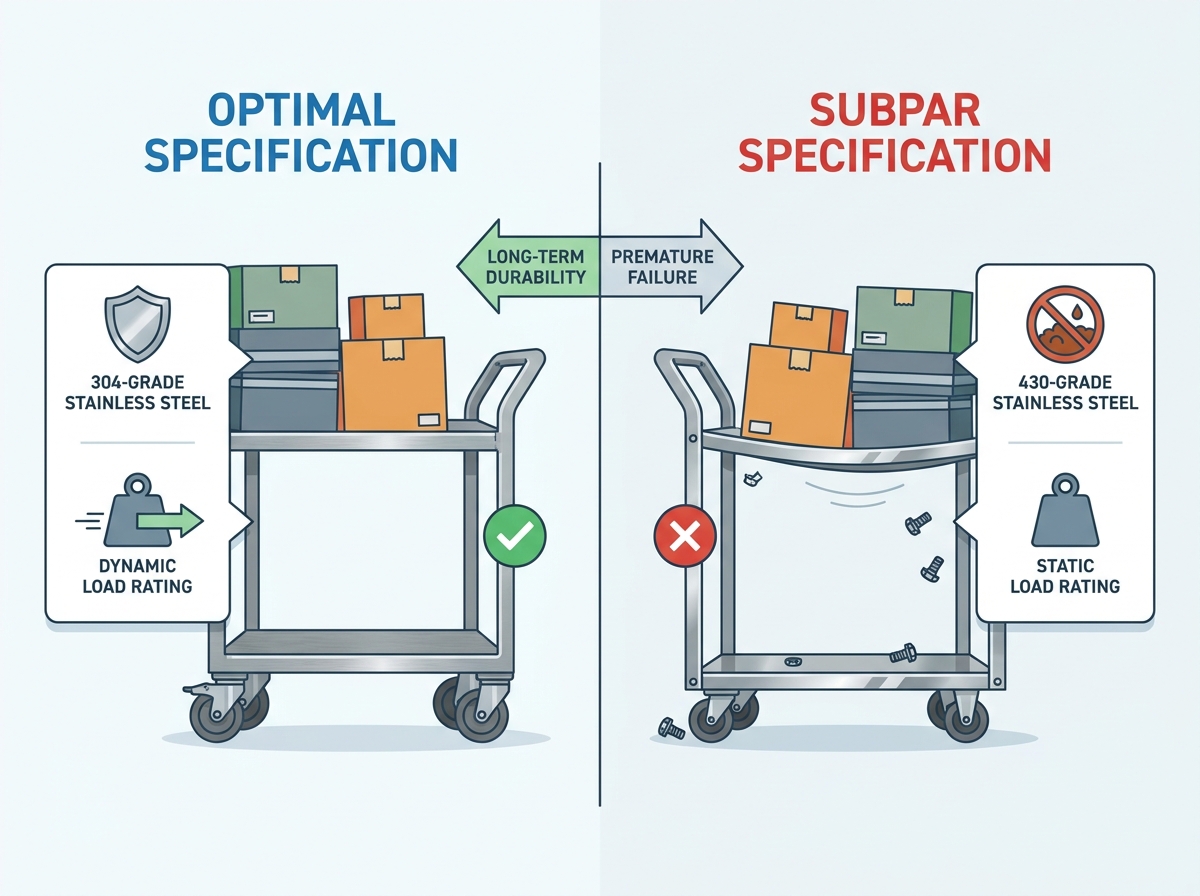
Steel Grade Matters Most: Prioritize 304-grade stainless steel for wet environments; 430-grade is acceptable only for dry, light-duty applications.
Verify Dynamic vs. Static Load: Never buy based on static load capacity alone; calculate the dynamic load rating to ensure safe mobility.
Inspect Caster Specifications: Look for TPR (Thermoplastic Rubber) or Polyurethane wheels with dual-locking mechanisms to prevent hazardous slipping.
Design for the Use Case: Raised shelf edges, specific tier clearances, and NSF certifications are non-negotiable for commercial environments.
Buyers often assume all stainless metal resists rust equally. This assumption creates significant business problems later. Lower grades succumb quickly to corrosion. Exposure to food acids or harsh sanitizing chemicals accelerates this decay. You must evaluate the specific alloy composition and metal thickness before deciding.
You need to look closely at the exact steel grade. Manufacturers primarily use three variations: 304, 430, and 201. The 304 grade features high nickel and chromium content. This specific blend provides superior rust resistance. It serves as the gold standard for medical facilities and wet food prep areas. Conversely, 430 and 201 grades offer lower manufacturing costs. They contain less nickel and react magnetically. You should only use these lower grades for dry storage.
Metal thickness plays an equally vital role. Industry standards measure this thickness using a "gauge" rating. A lower gauge number indicates thicker metal. Commercial heavy-duty environments require 16 to 18-gauge steel. This thickness confidently resists denting under heavy loads. Residential or light-duty models typically use 20 to 22-gauge steel. These thinner sheets easily flex and warp during intensive use.
Buying the wrong material carries severe implementation risks. Bringing a 201-grade unit into a humid commercial kitchen guarantees problems. Pitting and surface rust will appear within a single year. These defects harbor bacteria and invite immediate health code violations. You will face sudden replacement costs.
Steel Grade | Composition Profile | Primary Characteristics | Ideal Use Case |
|---|---|---|---|
304 Grade | High Chromium, High Nickel | Excellent rust resistance, non-magnetic | Wet prep, medical, intensive daily use |
430 Grade | High Chromium, Zero Nickel | Moderate rust resistance, magnetic | Dry storage, plating stations |
201 Grade | Low Nickel, High Manganese | Poor rust resistance, low cost | Light duty, climate-controlled rooms |
Manufacturers frequently advertise impressive load capacities on their packaging. You might see bold claims stating a unit holds 300 pounds. They rarely clarify this refers strictly to static load. Static load measures weight capacity while standing completely still. Moving that identical weight across a floor creates distinct stress. Hitting a tile grout line causes joint failure. You must differentiate between stationary limits and true operational weight limits.
Construction methods dictate how well a unit absorbs movement. Welded joints offer superior structural rigidity. They also improve overall hygiene. A continuous weld leaves no hidden crevices for bacteria to multiply. Knock-down units utilize bolted connections instead. They cost significantly less to ship. However, bolted assemblies require periodic tightening to maintain stability.
You need to scrutinize the dynamic load rating closely. This rating calculates safe capacity while in active motion. Look for a certified dynamic load capacity exceeding your heaviest expected operational use. A solid buffer of at least 20 percent prevents catastrophic buckling. Professional kitchens never push their equipment to the absolute maximum threshold.
Under-shelf reinforcement separates premium models from budget options. High-quality designs feature welded hat channels under every single tier. Some manufacturers utilize heavy-duty U-braces instead. These hidden structural supports prevent wide metal shelves from bowing inward over time.
A rugged heavy-duty body becomes entirely useless if the wheels fail. Casters routinely jam, vibrate noisily, or refuse to lock securely during loading. These failures turn a helpful tool into a severe workplace hazard. You should treat casters as a completely separate evaluation criteria during procurement.
Wheel material directly impacts floor protection and noise levels. Let us examine the top options available today:
TPR (Thermoplastic Rubber): This compound provides incredible shock absorption. It runs quietly across hard surfaces. It also prevents ugly scuff marks on expensive dining room floors.
Polyurethane and Nylon: These harder materials handle extremely heavy industrial loads. They suit warehouse environments perfectly. However, they generate substantial noise on uneven tile.
Locking mechanisms demand equal attention. You must require at least two locking casters per unit. Choosing four locking casters offers the safest configuration. Standard brakes only stop the wheel from rolling forward. You should specifically look for "total lock" brakes. These advanced mechanisms freeze wheel rotation and disable the swivel assembly simultaneously. This ensures absolute stability during loading.
Caster mounting styles determine long-term durability. Stem-mounted casters insert directly into tubular legs. Manufacturers favor them for affordability. Plate-mounted casters attach via a flat metal square secured by four distinct bolts. Plate mounts distribute operational stress over a significantly wider surface area. They survive harsh impacts much better than stem mounts.
Many designs look fantastic on paper but fail miserably in practice. Poor handle heights cause immediate operator fatigue. Inadequate shelf clearance forces staff to hand-carry tall appliances. Items sliding off flat edges during transit cause expensive breakage. You must map physical dimensions directly to the items transported.
Raised edges solve the sliding problem immediately. Professionals often call these marine edges. They provide essential liquid containment during accidental spills. A raised perimeter prevents fragile dishware from launching onto the floor during abrupt stops. This single feature saves restaurants thousands in replacement costs annually.
Tier clearance requires precise measurement before purchasing. Do not guess the required height. Measure the tallest items you intend to transport daily. You might move specific countertop appliances or bulk ingredient bins. Ensure the vertical distance between the second and third tiers comfortably accommodates your largest required item.
Handle design directly influences workplace ergonomics. Pushing heavily loaded equipment requires proper leverage. Look for comfortable, extended push handles. Manufacturers should position these handles at an ergonomic height. The industry standard sits between 34 and 38 inches from the floor. This exact positioning prevents unnecessary operator back strain during extended shifts.
Purchasing non-compliant equipment creates immense regulatory friction for B2B buyers. Health inspectors strictly penalize undocumented kitchen gear. Home users face different but equally serious challenges. Hard-to-clean residential units quickly become dangerous sanitary hazards. You must verify industry-standard certifications and sanitary design elements.
NSF certification remains an absolute requirement for commercial food service. The National Sanitation Foundation tests equipment rigorously. An NSF badge guarantees the design meets strict standards for public health protection. It proves the unit lacks inaccessible corners where harmful pathogens multiply unchecked.
Surface finish affects daily maintenance routines significantly. Mirror polishes look beautiful in showrooms. However, they show every single fingerprint and scratch immediately. You should look for a brushed or satin finish instead. Industry professionals often refer to this as a #4 finish. It hides daily wear exceptionally well while remaining simple to sanitize.
Applying a logical shortlisting method saves procurement time. Follow these specific steps to narrow your choices effectively:
Define the specific operational environment. Determine if it remains primarily wet or dry.
Calculate the true dynamic weight requirement. Add a 20 percent safety buffer to your heaviest typical load.
Filter your initial search strictly by 304-grade alloys and TPR shock-absorbing casters.
Verify current NSF certification credentials if operating within a commercial food service setting.
Purchasing the correct Stainless Steel Dinning Cart demands looking well past surface-level aesthetics. You must thoroughly evaluate steel grades, material gauge, dynamic load limits, and premium caster quality.
Do not compromise on securing 304-grade steel or total-lock wheels if your environment sees intensive daily use. Over-specifying slightly on dynamic load capacity remains the most effective strategy to ensure long-term mechanical durability.
Review your specific use-case requirements against the technical dimensions provided in this guide. Request detailed technical spec sheets from your suppliers before adding any model to your final procurement list.
A: 304 contains higher nickel content, making it highly resistant to rust and corrosion, ideal for food service and wet areas. 430 lacks nickel and is prone to rusting if exposed to moisture, making it suitable only for dry environments.
A: Yes, but only if it is constructed from 304-grade stainless steel. Even then, it should be covered when not in use to protect the caster bearings from weather damage.
A: Bolted (knock-down) carts naturally experience vibration during transport, which loosens hardware over time. To fix this, apply a thread-locking fluid to the bolts during assembly, or upgrade to a fully welded cart for high-frequency use.
A: Wipe down daily with warm soapy water and a microfiber cloth, always wiping in the direction of the metal grain. Avoid chlorine-based bleach or abrasive steel wool, as these strip the steel's protective passive layer and induce rusting.