


Views: 0 Author: Site Editor Publish Time: 2026-10-21 Origin: Site


Subpar utility carts carry hidden operational costs for many commercial businesses. You might routinely notice frequent caster replacements adding up. Distracting wheel noise disrupts quiet dining rooms and frustrates guests. Unsealed joints can quickly cause failed health inspections due to bacterial growth. These recurring issues plague many hospitality and medical environments. A utility cart is not merely a simple accessory. It serves as a high-frequency operational tool. It directly impacts your staff safety, daily service speed, and strict hygiene compliance. Ignoring these factors creates daily workflow disruptions. Operators must view this equipment seriously. This guide provides a clear evaluation framework. Buyers can seamlessly align technical specifications to their specific commercial environments. We will explore various steel grades, dynamic load limits, and caster types. Proper selection ensures long-term operational success. Choosing poorly leads to physical strain on workers. Choosing wisely boosts your daily efficiency. Let us dive into the details.
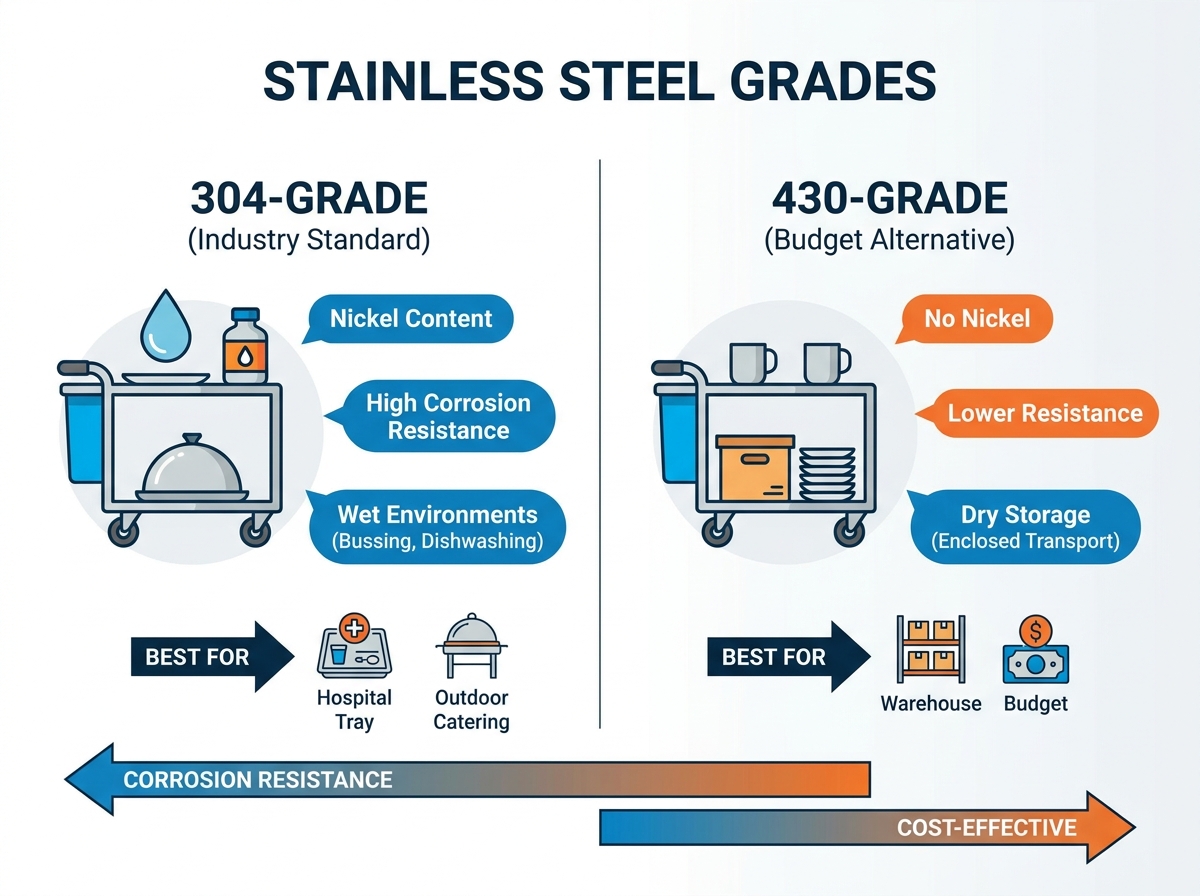
Material matters: 304-grade stainless steel is essential for wet environments; 430-grade suffices for dry storage.
Caster quality dictates lifespan: TPR (Thermoplastic Rubber) wheels prevent disruptive dining room noise and resist floor damage.
Dynamic vs. Static Load: Always evaluate carts based on dynamic load capacity (when moving), not just static weight limits.
Welded vs. Bolted: Welded carts offer superior longevity and hygiene, whereas bolted carts provide upfront freight savings but require ongoing maintenance.
Not all metal resists rust equally in a commercial kitchen. Commercial environments expose equipment to moisture, acidic foods, and harsh sanitizers. Buyers often misunderstand metal grading systems. They assume any shiny metal prevents corrosion entirely. This misconception leads to rapid equipment degradation.
The 304-grade alloy represents the industry standard for severe conditions. It contains high levels of nickel and chromium. This composition creates a robust protective layer. It strongly resists corrosion from acidic food spills. Harsh cleaning chemicals will not pit the surface easily. You should deploy 304-grade models in wet areas. They excel in bussing stations and dishwashing zones. Hospital food service and outdoor catering also demand this durability.
The 430-grade alloy serves as a reliable budget alternative. It lacks nickel entirely. This absence lowers its overall corrosion resistance. However, it remains highly durable against blunt physical impacts. It resists denting exceptionally well. You should assign 430-grade units to dry storage areas. They work perfectly for enclosed transport. Budget-constrained operations benefit greatly from this cost-effective option.
Metal thickness matters just as much as the alloy grade. Manufacturers measure this thickness using a gauge system. Lower numbers indicate thicker, stronger metal. You must look for 18-gauge or 20-gauge steel for heavy commercial use. These thicknesses support heavy loads without buckling. Flimsy 22-gauge options warp easily under heavy stacks of dishware. Avoid them for high-volume applications.
Material Grade Comparison
Specification | 304-Grade | 430-Grade |
|---|---|---|
Nickel Content | High (Excellent rust prevention) | None (Lower rust resistance) |
Best Environment | Wet, acidic, or highly sanitized areas | Dry storage and light transport |
Durability Focus | Chemical and corrosion resistance | Physical impact and dent resistance |
Price Point | Premium | Budget-Friendly |
Common Mistakes: Many operators buy 430-grade carts for dish rooms to save money. The high humidity quickly causes surface rust. This rust violates local health codes.
The structural integrity of the metal chassis usually lasts for decades. However, the unit outlasts its wheels 90 percent of the time. Caster failure represents the primary reason facilities discard equipment. Wheels endure constant friction, impacts, and chemical exposure. Selecting the right wheel material saves significant replacement costs.
Thermoplastic Rubber (TPR) wheels dominate front-of-house (FOH) applications. These wheels roll silently across hard floors. They absorb the shock of tile grout lines effortlessly. TPR materials will not leave ugly black scuff marks. They protect expensive dining room flooring. When selecting a Stainless Steel Dinning Cart, ensure it features TPR wheels for quiet service.
Polyurethane wheels serve back-of-house (BOH) environments better. Kitchens feature rougher floors and frequent grease spills. Polyurethane resists chemical breakdown from floor degreasers. It handles heavier loads without flattening out. It requires slightly more effort to push but offers unmatched durability.
Maneuverability requirements dictate the wheel configuration. Operations need precise steering in tight areas.
Standard Configuration: Two swivel casters and two fixed casters. This setup provides straight-line stability during long transports.
Tight Space Configuration: Four swivel casters. Staff can push the unit sideways into narrow gaps. It requires more effort to push in a straight line.
Braking Systems: Always demand step-on locking brakes. They prevent dangerous rolling during heavy loading tasks.
Best Practices for Caster Maintenance:
Inspect wheel bearings monthly for trapped debris or string.
Lubricate swivel brackets quarterly to ensure smooth turning.
Replace wheels immediately if they develop flat spots.
Manufacturers often use deceptive marketing regarding load capacities. You must understand the crucial difference between dynamic and static limits. A static limit measures the weight a stationary unit can hold. A dynamic limit measures the safe weight limit during motion. A unit rated for 300 lbs static may safely maneuver only 150 lbs dynamic. Motion multiplies stress on the joints and casters. Always base your purchasing decisions purely on the dynamic rating.
Sizing the equipment to your specific space prevents frustrating bottlenecks. You must measure your environment carefully before buying.
Measure the narrowest walk-in cooler doors in your facility.
Evaluate the width of all primary kitchen aisles.
Check the dimensions of service elevators.
Account for the turning radius needed at hallway corners.
Tier optimization directly influences your daily efficiency. Two-tier configurations provide ample vertical clearance. They handle bulky items easily. You can transport large stock pots or tall ingredient bins. Three-tier configurations maximize total surface area. They work best for bussing tables quickly. They allow staff to stack multiple shallow tubs in tight spaces.
Edge design plays a critical role in safety and cleanliness. High-quality units feature hemmed, folded edges. Raw metal edges can cause severe lacerations. Hemming folds the sharp metal back onto itself safely. Furthermore, raised lips prevent liquid spills from dripping onto floors. This containment reduces slip-and-fall hazards significantly.
Buyers must choose between two primary assembly methods. Knock-down (KD) models arrive disassembled in flat boxes. Fully welded models arrive fully assembled and ready for immediate use. Each style fits different operational needs and budgets.
Knock-down units offer clear logistical benefits. They cost less to ship due to compact packaging. The upfront purchase price remains generally lower. However, KD units require ongoing mechanical maintenance. Constant rolling vibration loosens screws and bolts over time. Staff must perform routine tightening. Additionally, the overlapping metal joints can harbor moisture and bacteria. This poses a slight hygiene risk in critical care settings.
Fully welded units deliver maximum structural rigidity. Manufacturers fuse the metal seams permanently. These units lack screws or bolts entirely. They never loosen or rattle during operation. Seamless joints meet strict NSF and hygiene standards easily. Staff can steam-clean them without forcing water into hidden crevices. The main drawback involves higher freight costs due to large shipping volumes.
Assembly Decision Matrix
Criteria | Knock-Down (Bolted) | Fully Welded |
|---|---|---|
Initial Purchase Price | Lower | Higher |
Shipping Costs | Economical (Flat packed) | Expensive (Large volume) |
Structural Maintenance | Requires regular bolt tightening | Zero structural maintenance |
Hygiene Level | Moderate (Joints can trap debris) | Excellent (Seamless design) |
Ideal Use Case | Light-duty or intermittent tasks | High-volume, continuous use |
Choosing a reliable vendor prevents future supply chain headaches. You should evaluate vendors based on their post-purchase support. Warranty length indicates the manufacturer's confidence in their product. Advise your procurement team to check parts availability. Determine if the vendor sells replacement casters separately. A vendor selling replacement parts signals a repairable, long-term product. Disposable products rarely offer spare parts.
Compliance verification ensures facility safety. You must look for prominent NSF certification marks. The National Sanitation Foundation tests equipment for public health safety. They verify the metal grades and inspect joint seamlessness. Equivalent local health ratings also provide peace of mind. Investing in a certified Stainless Steel Dinning Cart speeds up health department inspections.
Vendor trust signals separate reputable suppliers from temporary importers. Evaluate the vendor's B2B fulfillment track record. Read their policies regarding damaged freight clearly. Commercial equipment sometimes sustains damage during transit. A strong return policy protects your capital. Legitimate vendors also disclose exact steel grades transparently. Avoid sellers using vague terms like "premium metal" without specifying the exact 304 or 430 gauge rating.
Choosing the correct utility equipment requires balancing immediate constraints with environmental demands. Wet environments and heavy loads demand higher steel grades and stronger casters. You must match the wheel type to your flooring to maintain a quiet, professional atmosphere.
Audit your floor surfaces to determine if TPR or Polyurethane wheels suit you best.
Measure your narrowest door frames and aisles before committing to a specific size.
Determine your primary workflow (bussing vs. bulk transport) to choose between two or three tiers.
Prioritize fully welded joints if you operate in a strict, high-volume hygiene environment.
Taking these steps ensures you equip your staff with reliable tools. Improved tools boost morale and accelerate daily workflows. Browse your preferred vendor's catalog of commercial-grade models today. You can also contact a sales representative for a custom workflow consultation tailored to your facility.
A: The primary differences involve material finish, hygiene standards, and wheel noise. Dining models prioritize food-safe finishes and spill-containing raised edges. They feature specialized TPR casters designed for silent operation in front-of-house service. Standard utility versions often use louder wheels and flatter edges suited strictly for back-of-house tasks.
A: "Stainless" does not mean entirely stain-proof. You must clean the metal daily using mild detergents. Avoid chlorine-based bleach or abrasive steel wool pads entirely. Always wipe the surfaces completely dry after cleaning. This practice protects the vital chromium oxide layer that naturally prevents rust formation.
A: Not always. Three-tier configurations hold more numerous small items, like bussing tubs and plates. However, two-tier configurations provide significantly more vertical clearance. This extra height allows staff to safely transport tall appliances, large stock pots, or oversized ingredient bins without spatial restrictions.
A: For reliable commercial use, look for a minimum dynamic load capacity ranging from 300 to 500 lbs. This weight must remain evenly distributed across all shelves. Always verify the dynamic limit, as static limits falsely inflate the perceived strength of the unit during actual motion.