


Views: 0 Author: Site Editor Publish Time: 2026-10-23 Origin: Site


Spring turkey hunting consistently exposes shotguns to the absolute worst elements. You battle high humidity, sudden downpours, and abrasive brush daily. Standard blued barrels demand meticulous daily oiling just to prevent rust in these harsh conditions. This relentless maintenance pushes many hunters toward weather-resistant upgrades. A successful upgrade requires a careful balance of distinct features. You need extreme corrosion resistance alongside optimal field maneuverability. You must achieve tight pattern density for modern turkey loads. Crucially, you need zero glare to avoid spooking sharp-sighted birds. This guide provides a strict evaluation framework. We will help you select a Stainless Steel Turkey Barrel ready for adverse conditions. You will learn how to maximize performance without compromising vital field stealth.
Corrosion Resistance vs. Maintenance: Stainless steel significantly delays rust and pitting from field moisture, but it is not 100% maintenance-free.
Optimal Dimensions: Dedicated turkey barrels should prioritize shorter lengths (20”–24”) for rapid target acquisition and brush maneuverability.
The Glare Factor: Raw stainless can spook turkeys; buyers must select matte, bead-blasted, or coated finishes.
Load Compatibility: The barrel must feature robust threading to handle extended, tight-constriction turkey chokes and modern Tungsten Super Shot (TSS) payloads.
Hunting environments routinely test the limits of firearm metallurgy. Traditional carbon steel succumbs quickly to moisture. Dew, rain, and swamp humidity attack exposed metal aggressively. Upgrading to a specialized barrel changes this dynamic entirely. A 416R stainless alloy provides a significant metallurgical advantage. It contains higher chromium levels to resist oxidation naturally. This material choice delays rust formation dramatically. You can sit in a damp turkey blind for hours without worry.
Modern turkey ammunition puts immense stress on barrel internals. High-pressure 3-inch or 3.5-inch magnum loads generate extreme friction. Standard barrels often show premature wear under these conditions. Stainless steel excels at resisting bore erosion. It maintains internal integrity even when firing dense tungsten payloads repeatedly. Pitting becomes far less common over multiple hunting seasons. This bore longevity directly preserves pattern consistency. Consistent patterns mean more ethical harvests.
Every hunter knows the exhaustion of returning to camp. You strip off wet gear and want to rest. Traditional shotguns demand immediate oil wipe-downs to survive the night. Stainless steel lowers this field-maintenance burden significantly. We must set realistic expectations, however. A stainless barrel reduces the need for frantic mid-hunt oiling. You can wipe it down hours later without seeing orange rust. Yet, it still requires standard post-season cleaning. Carbon buildup and plastic wad residue still accumulate inside the bore.
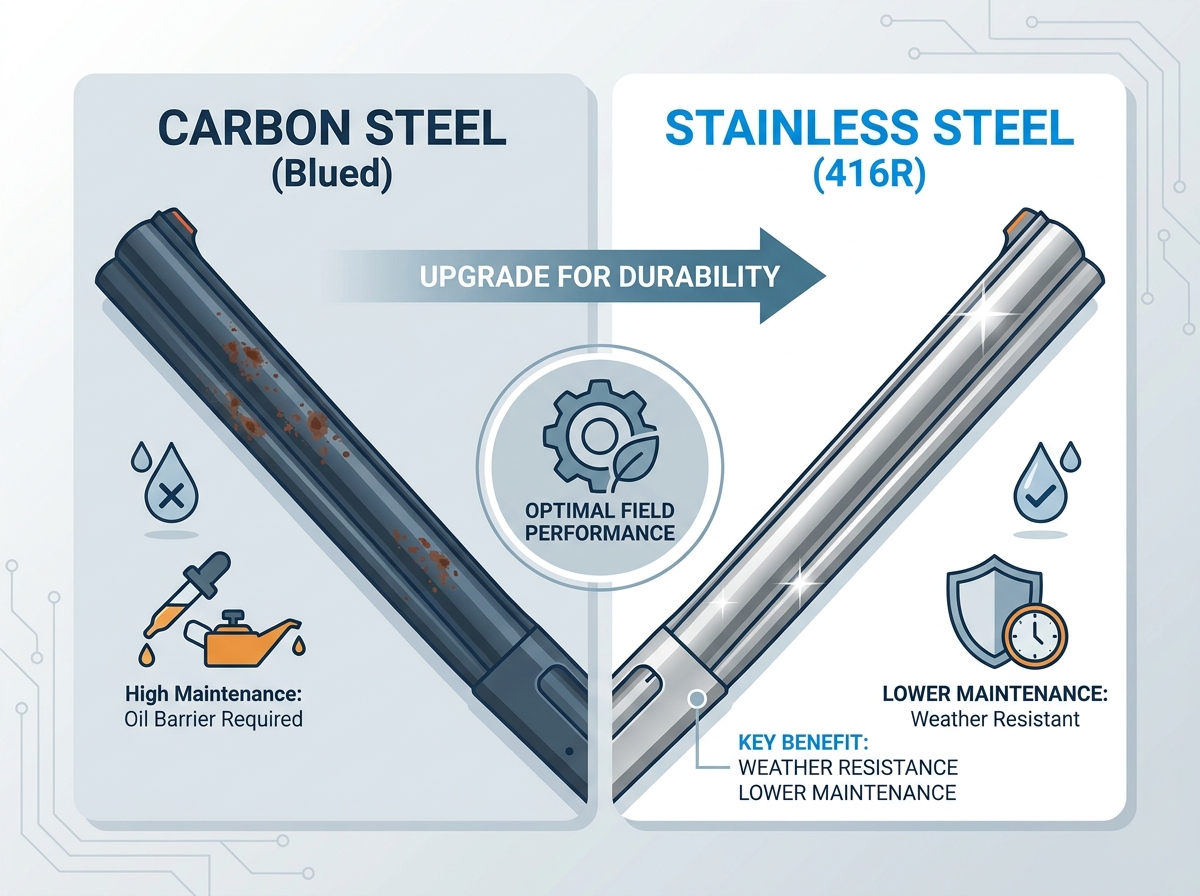
Evaluating barrel finishes requires understanding oxidation mechanics. Blued steel relies on a microscopic layer of black oxide. This oxide layer holds oil to repel water. It requires an unbroken oil barrier to prevent rust. If rain washes the oil away, the metal rusts rapidly. Stainless steel offers inherent material resistance instead. The metal itself fights oxidation. Scratches on a blued barrel expose raw, vulnerable steel. Scratches on stainless merely expose more stainless steel.
Thermal dynamics play a subtle role in firearm longevity. Rapid firing heats barrels quickly, causing metal expansion. Heat dissipation matters greatly for high-volume wing shooting. Single-shot turkey hunting operates differently. You rarely fire more than once or twice in a morning. However, rapid heat spikes from magnum loads still stress the chamber. Stainless steel handles sudden thermal shock effectively. It resists throat erosion during those high-pressure single shots. This ensures your chamber remains within factory tolerances for years.
Many hunters hesitate at the higher upfront price tag. We must frame this cost against the firearm's total lifespan. Neglected blued barrels degrade rapidly in wet spring climates. Pitting inside the bore ruins tight choke performance permanently. A ruined barrel requires a complete replacement. Investing in premium stainless steel acts as insurance. It protects your shotgun against unpredictable weather events. The extended lifespan easily justifies the initial purchase price.
Comparison Chart: Stainless vs. Blued Shotgun Barrels
Feature | Blued Steel | Stainless Steel |
|---|---|---|
Rust Resistance | Low (Relies on oil barrier) | High (Inherent material property) |
Field Maintenance | High (Daily wipe-downs required) | Low (Occasional cleaning sufficient) |
Wear Resistance | Moderate | Excellent (Resists bore erosion) |
Initial Cost | Lower | Higher |
Traditional shotguns often feature 28-inch barrels designed for waterfowl. These longer tubes excel at swinging smoothly on flying ducks. However, they become a massive liability in the turkey woods. Dense underbrush snags long barrels constantly. Maneuvering a 28-inch gun inside a pop-up blind feels impossible. You must prioritize rapid target acquisition and unrestricted movement. We recommend dedicated lengths between 20 and 24 inches. A compact setup allows seamless adjustments when a tom approaches from an unexpected angle.
Hunters often worry about losing lethality with shorter guns. This concern stems from outdated velocity myths. Older powders required longer tubes for complete combustion. Modern turkey loads utilize fast-burning proprietary powders. They achieve full powder burn within the first 18 inches. A shorter barrel does not reduce lethality at ethical ranges. Shots under 50 yards rely entirely on pattern density, not raw velocity. Choke constriction dictates that density far more than overall length.
The internal geometry directly impacts your final pattern. The forcing cone acts as a transition zone. It connects the wide chamber to the narrower main bore. Standard factory cones are often short and abrupt. Pellets slam into this steep angle violently upon ignition. This impact deforms lead and causes erratic flyers. A lengthened, polished forcing cone solves this issue. It creates a gentle, elongated taper for the payload. This reduces pellet deformation dramatically and tightens overall patterns. It also mitigates perceived recoil against your shoulder.
Bore tolerances vary significantly among shotgun manufacturers. You must understand standard versus overbored profiles. Standard bores measure around .729 inches for a 12-gauge. Overbored or back-bored barrels expand this internal diameter slightly. This extra room reduces friction for dense turkey payloads. Less friction means fewer deformed pellets reaching the choke. When combined with a Stainless Steel Turkey Barrel, overboring yields highly uniform shot strings. Always verify the bore profile before purchasing aftermarket chokes.
Interchangeability remains a non-negotiable factor. Your new setup must accept industry-standard thread patterns. Proprietary or obscure threads limit your aftermarket options severely. Look for proven designs like Rem Choke, Invector-Plus, or Mobil. These standards ensure access to premium, extra-full turkey chokes. Different ammunition types prefer different constrictions. You need the freedom to swap tubes easily during patterning sessions. A universal thread pattern guarantees this flexibility.
Modern hunting relies heavily on Tungsten Super Shot (TSS). TSS pellets are substantially harder than lead or bismuth. They do not compress when squeezed through a tight choke. This creates immense lateral pressure at the muzzle. You must verify the barrel's muzzle wall thickness. Thin walls can bulge or split under extreme constrictions. Robust steel construction safely accommodates the pressure of heavy tungsten loads. Always inspect the threading depth and wall integrity before shooting TSS.
Turkeys possess some of the most exceptional eyesight in nature. They detect unnatural reflections instantly. They also see into the UV light spectrum. A highly polished, shiny firearm is a massive liability. Sunlight glinting off raw metal will spook birds from hundreds of yards away. You must hide your equipment carefully. Choosing a weather-resistant material does not mean accepting visual exposure. You must address the avian vision problem directly.
Manufacturers understand this critical concealment requirement. Factory finish options now cater specifically to hunters. You should never buy a high-gloss sporting clays finish for the woods. Instead, evaluate bead-blasted or matte finishes. Bead blasting roughs up the metal surface microscopically. This texture diffuses light effectively instead of reflecting it. A matte finish provides the weatherproofing of bare metal without the harsh shine. It blends well into shadowed timber and dense brush.
Some hunters require maximum camouflage regardless of lighting conditions. Secondary treatments offer the ultimate solution for shiny metals. Consider these popular concealment strategies:
Cerakote Applications: A baked-on ceramic coating that eliminates glare entirely. It adds a secondary layer of extreme wear resistance over the metal.
Camo-Dipping (Hydrographics): Applies specific camouflage patterns directly to the exterior. This matches your gear to local foliage perfectly.
Aftermarket Vinyl Wraps: An inexpensive, removable option. Wraps protect the underlying finish and break up the gun's outline quickly.
Finding the perfect upgrade begins with strict receiver compatibility. Shotgun actions are not universally interchangeable. You cannot force a Remington barrel onto a Mossberg receiver. You must verify the exact make, model, and gauge of your firearm. Pay attention to specific sub-models and manufacturing years. Some brands altered their locking lug designs over time. Always cross-reference the manufacturer's part numbers before completing a purchase. A sloppy fit creates dangerous headspace issues.
Sighting systems dictate your accuracy at extended distances. Traditional brass beads fail completely in low-light woods. Turkeys possess tiny vital zones requiring precise aim. Look for options with pre-installed cantilever mounts. These allow you to mount red dot optics directly to the barrel. If you prefer iron sights, seek out tapped receivers or high-visibility adjustable fiber-optics. Rifle-style sights allow you to adjust windage and elevation. This corrects any point-of-impact shifts caused by heavy payloads.
Follow a structured implementation plan once your upgrade arrives. Follow these numbered steps to guarantee field readiness:
Install the barrel and verify smooth pump or semi-auto cycling.
Purchase a verified, pattern-tested choke tube rated specifically for tungsten.
Buy two distinct brands of TSS ammunition (e.g., #7 or #9 shot) for initial patterning.
Shoot at life-sized targets at 20, 30, and 40 yards to map the exact point of impact.
Adjust your optics or fiber-optic sights to center the core of the pattern.
Upgrading your shotgun requires strategic decision-making. We have established that a specialized, corrosion-resistant tube is a functional, weather-beating tool. It eliminates the anxiety of rust during sudden spring downpours. However, the hunter must carefully account for the exterior finish and overall length. Raw, shiny metal will defeat your stealth efforts entirely. Excessively long tubes will hinder your movement in tight brush.
We advise buyers to prioritize specific dimensions for maximum return on investment. Seek out a 20-inch to 22-inch matte-finished option. Ensure it features an extended forcing cone to optimize dense pellet clusters. This specific configuration balances agility, stealth, and lethal ballistics perfectly. It prepares you for any scenario the turkey woods might present.
Take immediate action to prepare for the upcoming season. Pull your shotgun from the safe today. Check the exact model specifications stamped on the receiver. Browse compatible aftermarket upgrades prioritizing matte finishes and robust choke threading. Equip yourself properly, pattern your loads diligently, and enter the woods with absolute confidence.
A: Yes. While highly rust-resistant, stainless steel contains iron and can develop surface rust if left in damp, enclosed cases. Light lubrication is still required to maintain the metal and prevent long-term pitting.
A: Yes, the barrel material easily handles TSS. However, the critical factor is ensuring your choke tube is specifically rated for tungsten to prevent muzzle swelling or thread damage under extreme pressure.
A: No. Modern turkey loads achieve full powder burn quickly. Pattern density, which is determined by your choke and ammo selection, dictates range far more than a few extra inches of overall length.
A: Usually yes, if you are well-concealed in the shadows of a blind or deep timber. However, in direct sunlight, applying camo tape or a Cerakote finish provides optimal concealment against their sharp vision.