


Views: 0 Author: Site Editor Publish Time: 2026-10-22 Origin: Site


In high-volume food service, transport equipment is often an afterthought. Managers usually ignore it until it fails. Then, broken wheels or warped shelves cause serious operational bottlenecks. They can even trigger severe compliance violations during surprise health inspections. While polymer and aluminum carts offer lower entry prices, modern institutional kitchens demand more. Commercial operations increasingly standardize on steel for unyielding reliability. Upgrading to a Stainless Steel Dinning Cart is a strategic operational decision. It is driven by strict sanitation standards and rigorous daily demands. Heavy loads, scalding temperatures, and abrasive chemicals easily destroy cheaper materials over time. This guide breaks down the verifiable operational benefits of these heavy-duty assets. You will learn material evaluations, structural differences, and implementation realities. Ultimately, standardizing on stainless steel service carts protects your daily workflow. It guarantees fewer disruptions and better hygiene.
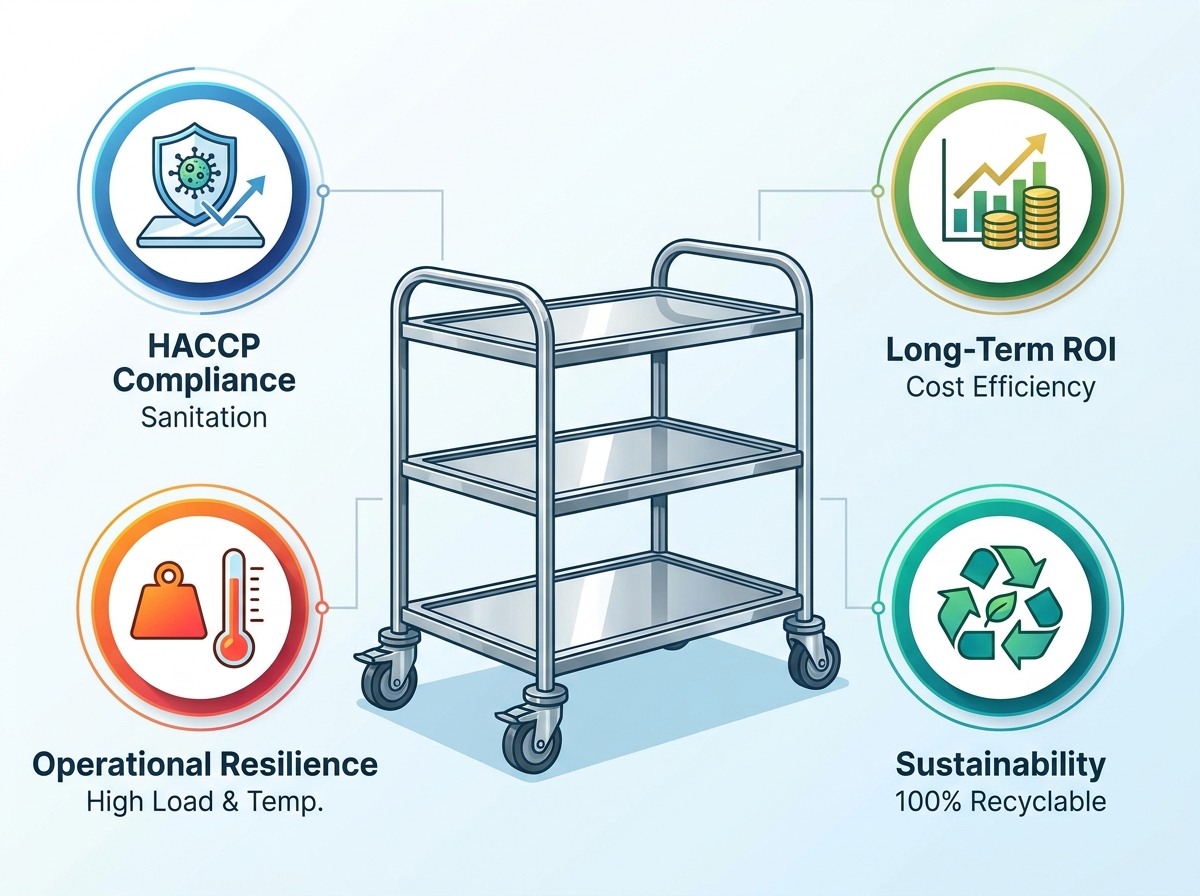
Compliance & Hygiene: Non-porous stainless steel actively supports HACCP protocols and resists bacterial harboring better than textured plastics.
Long-Term ROI: Despite a higher initial procurement cost, the extended lifecycle (often 10+ years) significantly lowers the Total Cost of Ownership.
Operational Resilience: High load-bearing capacity and thermal shock resistance make steel carts versatile for both walk-in freezers and hot-line service.
Sustainability: Commercial-grade stainless steel is 100% recyclable, aligning with institutional ESG (Environmental, Social, and Governance) purchasing mandates.
Kitchen managers face intense pressure to maintain efficiency. Material choice directly impacts how well a kitchen operates during peak hours. Inferior materials create hidden friction points that slow down service.
Polymer carts frequently suffer from structural warping. When you place hot hotel pans directly on plastic shelves, the material softens. Aluminum carts present different challenges. They suffer from cosmetic denting after minor collisions. Aluminum also oxidizes when exposed to acidic food spills. These material failures force kitchens into a cycle of frequent replacements. The initial savings quickly evaporate.
To break this cycle, operations must define strict success criteria for food transport. Procurement teams should mandate the following baseline requirements:
Load Stability: Shelves must hold heavy bulk liquids without sagging.
Ease of Sanitation: Surfaces must withstand aggressive chemical degreasers.
Maneuverability: Carts must navigate tight corridors and swinging doors easily.
Regulatory Compliance: Materials must meet localized health department regulations.
You must transition the conversation from simply buying a cart to investing in a mobile asset. A robust cart reduces liability. It prevents staff injuries from collapsed shelves. It also prevents cross-contamination. Viewing these items as permanent assets changes your procurement strategy entirely.
Food safety depends on easily cleanable surfaces. Plastics inevitably develop micro-scratches from daily use. These tiny abrasions become breeding grounds for pathogens like Salmonella. Unlike plastics, stainless steel provides a highly cleanable, impervious surface. Its non-porous surface dynamics prevent bacteria from hiding. You can wipe it completely sterile with minimal effort.
Commercial kitchens also use aggressive cleaning methods. A Stainless Steel Dinning Cart withstands harsh commercial degreasers perfectly. It handles quaternary sanitizers without degrading. You can even apply direct steam cleaning. The metal will never leach chemicals into the food zone. It will not melt or warp under intense thermal shock.
This material choice significantly simplifies regulatory alignment. Health inspectors look closely at food transport equipment. Stainless steel simplifies passing localized health inspections. It inherently adheres to NSF/ANSI standards for food zone surfaces. A clean, shiny cart demonstrates a clear commitment to HACCP protocols.
Common Mistake: Using chlorine-based bleach on stainless steel. Bleach attacks the protective chromium oxide layer. Always use quaternary ammonia or specialized metal sanitizers instead.
Transporting bulk ingredients requires immense structural strength. Steel possesses superior tensile strength compared to aluminum or plastic. This allows for significantly higher weight capacities per shelf. You can confidently transport large cambros of soup. You can move stacks of heavy ceramic dishware safely. Proper weight distribution prevents the center of the shelf from bowing.
Kitchens are high-traffic, chaotic environments. Collisions happen constantly. Carts hit swinging doors, wall corners, and other equipment. Stainless steel offers exceptional impact resistance. A steel cart survives these daily impacts without catastrophic frame failure. It maintains its structural squareness. This ensures the cart rolls straight instead of pulling to one side.
Modern institutions prioritize green purchasing initiatives. Environmental, Social, and Governance (ESG) mandates influence procurement. You must consider the lifecycle sustainability of your equipment. A steel cart prevents early landfill disposal. Its long service life means you consume fewer resources over a decade.
Furthermore, commercial-grade stainless steel is fully recyclable at its end of life. It retains inherent scrap value. You do not just throw it away. It returns to the supply chain to become new products. This supports zero-waste initiatives in corporate and healthcare dining sectors.
Unmodified metal carts can create significant noise pollution. They amplify vibration and clattering sounds as they roll over grout lines. This rattling disrupts guest experiences in fine dining rooms. It also disturbs resting patients in hospital wards. Kitchen managers often overlook this acoustic risk.
You can easily mitigate this issue. Specify carts manufactured with sound-deadening materials. Look for rubberized under-shelf pads. These pads absorb vibrations before they echo. Ensure the cart features vibration-absorbing construction at the weld points. This simple specification turns a noisy industrial cart into a silent service tool.
The cart body almost always outlasts its mobility hardware. A steel cart becomes completely useless if the casters seize. They can also shear off under heavy loads. Cheap casters ruin expensive carts.
You must evaluate caster specifications strictly during procurement. Insist on high-quality materials.
Material: Require non-marking TPR (Thermoplastic Rubber) or Polyurethane.
Maintenance: Ensure they have accessible grease fittings (Zerk fittings) for lubrication.
Size: Demand a minimum 5-inch diameter to clear thresholds easily.
Safety: Mandate dual-locking mechanisms that secure both the wheel and the swivel.
Best Practice: Implement a monthly caster maintenance schedule. Clean out debris like mop strings. Lubricate the bearings to extend the cart's life.
Not all stainless steel performs identically. The specific alloy grade determines corrosion resistance and overall durability. You must match the metal grade to your specific facility environment.
The 304 grade represents the gold standard. It contains higher nickel content. This provides superior rust and corrosion resistance. It is ideal for high-moisture environments. Use 304 grade in hospitals, dish pits, and coastal locations.
The 201 grade serves as the budget alternative. It features lower nickel and higher manganese. It is suitable for dry transport tasks. You can use it for front-of-house busing where budgets are constrained. However, it requires stricter drying protocols. You must prevent standing water to avoid superficial oxidation.
Comparison Chart: 304 vs. 201 Series Stainless Steel
Feature | 304 Grade | 201 Grade |
|---|---|---|
Nickel Content | High (Typically 8-10.5%) | Low (Typically 1-5.5%) |
Corrosion Resistance | Excellent in wet environments | Moderate; best for dry zones |
Price Point | Premium investment | Budget-friendly |
Ideal Application | Dishwashing lines, cold storage | Dry pantry storage, dining room busing |
Construction methods heavily influence long-term stability. You can choose fully welded carts or knocked-down models. Fully welded carts feature zero mechanical fasteners. There are no bolts to loosen over time. They offer maximum structural rigidity. However, they incur much higher freight costs due to their bulky shipping size.
Knocked-down (KD) carts arrive unassembled. They offer significantly lower shipping costs. It is also easier to replace individual tiers if one gets severely damaged. The main risk involves vibration. Bolts can easily loosen under heavy daily use. You must assign maintenance staff to periodically tighten these fasteners.
Do not order equipment blindly based on catalog pictures. You must audit your current workflows first. Measure all physical constraints. Measure your aisle widths and doorway clearances. Note the turning radius in your walk-in coolers. Measure the standard bus tubs and hotel pans used in your facility. These dimensions dictate your required tier spacing and overall cart sizing.
Evaluate your budget efficiency over the long haul. Create a financial matrix. Compare a cheaper cart that you must replace every two years. Weigh that against a commercial Stainless Steel Dinning Cart lasting ten or more years. The extended longevity of steel always proves more economical. You eliminate recurring replacement costs and associated administrative headaches.
Establish strict supplier vetting criteria. Shortlist vendors who operate with high transparency. They must provide verifiable load-testing data. They should clearly state their steel grade specifications. Look for robust warranty terms. Ensure they sell accessible replacement casters for future maintenance.
Take an actionable next step today. Request spec sheets and physical samples from your shortlisted vendors. Run a pilot test in the most demanding zone of your kitchen. Put the sample in the dishwashing staging area. See how it handles water, heat, and heavy impacts over a two-week period.
Purchasing a heavy-duty steel cart serves as a vital preventative measure. It actively guards against operational downtime and painful sanitation breaches. It halts recurring equipment expenditures that drain your kitchen's budget. While alternative materials exist for light-duty tasks, they fail under pressure. High-volume commercial, healthcare, and hospitality operations require something stronger. They need the verifiable durability and superior hygiene profile of true stainless steel. Stop settling for disposable transport equipment. Consult with an equipment specialist today. Audit your current transport fleet. Spec out the exact heavy-duty configurations your facility needs to thrive.
A: "Stainless" does not mean "stain-proof." While 304-grade highly resists rust, improper care causes issues. Exposure to chlorine-based bleach strips its protective layer. Leaving standing water or acidic food spills can also cause surface oxidation. Always follow proper cleaning protocols using mild alkaline cleaners to prevent rusting.
A: Standard commercial carts typically hold between 300 lbs and 500+ lbs of evenly distributed weight. However, the true limit usually depends on the caster rating rather than the steel shelves. Always check the manufacturer's load-testing data to ensure it meets your bulk transport needs.
A: Use mild alkaline cleaners and warm water. Always wipe in the direction of the metal grain to prevent scratching. Avoid abrasive scouring pads and steel wool entirely. Finally, routinely check caster bolts for tightness and lubricate the wheel bearings to ensure smooth mobility.