


Views: 0 Author: Site Editor Publish Time: 2026-10-27 Origin: Site


Procurement decisions in commercial kitchens carry high stakes. Equipment failure mid-service disrupts daily operations and ultimately hurts your bottom line. You might view a Stainless Steel Soup Barrel as a simple, everyday vessel. However, it functions as a critical operational asset. It directly controls heat distribution, ensures food safety, and dictates daily kitchen efficiency. Choosing the wrong equipment leads to scorched batches, cross-contamination, and immediate operational bottlenecks.
We designed this guide to help you make the right choice. Our strictly evidence-based framework will show you exactly how to evaluate, shortlist, and source commercial soup barrels. You will learn to navigate complex material grades, assess structural integrity, and determine true working capacity. By the end, you will have the exact criteria needed to protect your food quality and streamline your kitchen workflow.
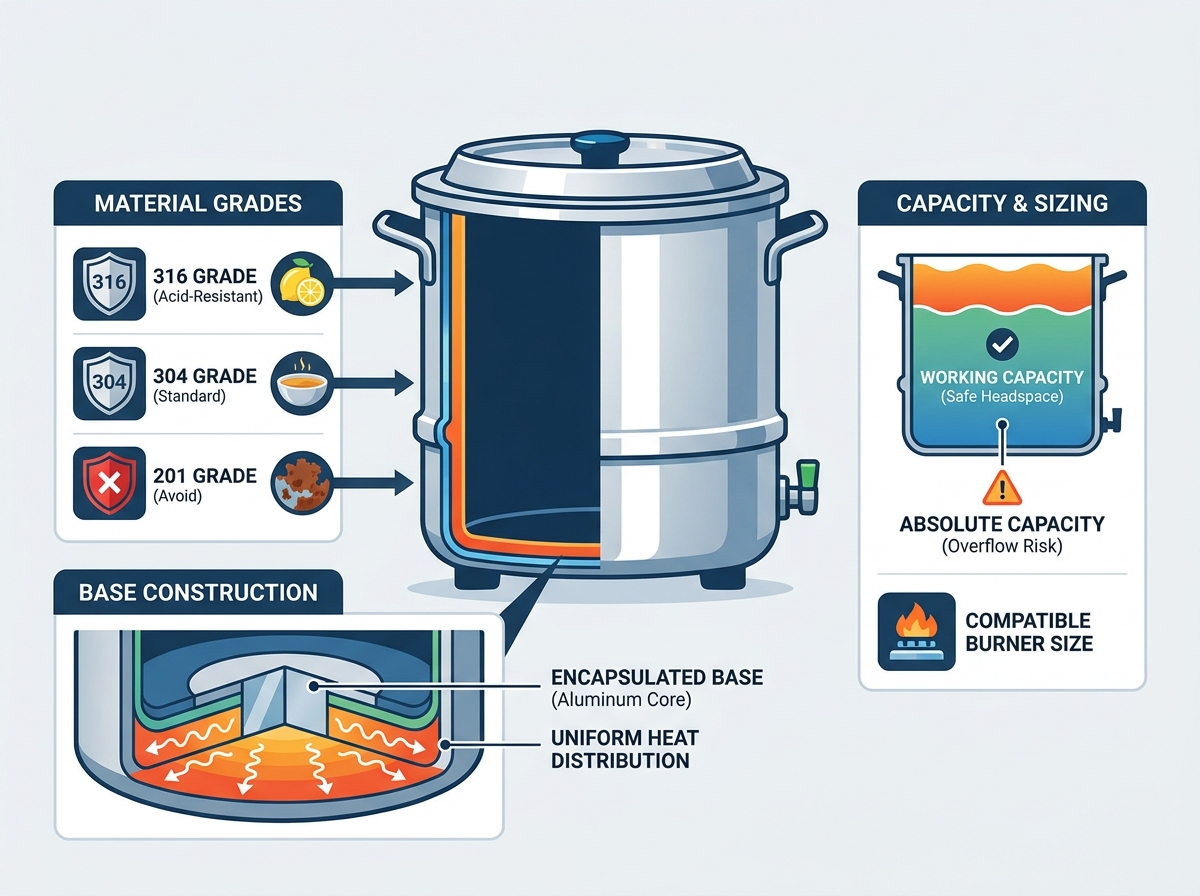
Material dictates lifespan: 304-grade stainless steel is the commercial baseline; 316-grade is required for highly acidic or fermented contents. Avoid 201-grade for food contact.
Construction impacts food quality: Encapsulated, heavy-gauge bottoms are mandatory to prevent scorching thick liquids and soups.
Size for scale, not just volume: Factor in headspace requirements for boiling or fermentation to prevent overflow and cross-contamination.
Hygiene depends on hardware: Opt for seamless interiors and welded (or high-clearance riveted) handles to pass stringent health inspections.
Stainless steel comes in various grades. Manufacturers classify these based on their metallurgical composition. You must understand these differences to ensure food safety and equipment longevity. Using the wrong grade compromises your entire operation.
The 300 series represents the gold standard for commercial food preparation. Within this family, 304 stainless steel stands as the undisputed industry baseline. Manufacturers often label it as 18/8 or 18/10. These numbers represent the chromium and nickel percentages. High chromium provides excellent corrosion resistance. This makes 304 steel ideal for standard broths, meat stocks, and daily commercial kitchen use.
If your menu relies heavily on highly acidic foods, you must upgrade to 316 stainless steel. This grade contains molybdenum. Molybdenum specifically fortifies the metal against harsh chlorides and acids. Tomato bases, citrus-heavy sauces, and vinegar-rich reductions will aggressively attack lesser metals. Furthermore, businesses operating fermentation or brewing lines absolutely require 316-grade material. Acidic degradation creates microscopic pitting over time. These tiny craters harbor bacteria and ruin subsequent batches.
Some suppliers aggressively market 200-series steel, particularly 201-grade, as a budget-friendly commercial option. You should strictly avoid this material for direct food contact. Manufacturers replace much of the nickel in 201 steel with manganese to cut costs. This drastically reduces its rust resistance. Under heavy-duty commercial use, 201-grade steel poses severe risks. Constant exposure to moisture and high heat causes premature rusting. Worse, it risks metallic leaching into your food. This compromises flavor profiles and violates health codes.
Never take supplier claims at face value. You must verify food-grade certification before finalizing any purchase. Unverified metals introduce unnecessary risks to your kitchen. To validate supplier claims, practice the following protocols:
Demand raw material test reports directly from the manufacturer.
Look for prominent NSF (National Sanitation Foundation) compliance certificates.
Request independent lab testing results verifying the chromium and nickel percentages.
Check the stamping on the bottom of the barrel for official grade markings.
Comparison of Stainless Steel Grades for Commercial Kitchens
Steel Grade | Primary Composition | Best Culinary Application | Corrosion Resistance |
|---|---|---|---|
304 (18/8 or 18/10) | 18% Chromium, 8-10% Nickel | Standard broths, daily kitchen prep | High |
316 | Adds Molybdenum | Tomato bases, fermentation, high-acid foods | Very High |
201 | Low Nickel, High Manganese | Non-food contact, dry storage only | Low |
Choosing the correct size involves more than matching a number to your recipe output. A Stainless Steel Soup Barrel operates dynamically. Heat, bubbling, and expansion drastically alter how much liquid you can safely process at once.
You must clearly understand the difference between absolute capacity and working capacity. Absolute capacity represents the vessel filled brim-full. You can never cook at absolute capacity. Working capacity leaves essential safe headspace. This headspace accommodates rolling boils, ingredient displacement, and fermentation expansion.
To calculate your required capacity accurately, follow these steps:
Determine your target yield in liters or gallons for a single batch.
Add a 20% to 25% safety buffer for standard broths to prevent overflow.
Add a 30% to 40% safety buffer for starchy liquids, thick chowders, or fermentation processes.
Select a barrel where your target yield matches the calculated working capacity, not the absolute brim limit.
Translating this to commercial serving sizes simplifies planning. For example, a 50-liter barrel realistically outputs about 40 liters of safe, usable soup. This translates to roughly 160 standard 250ml portions per batch.
Capacity directly impacts the physical footprint of your equipment. Assess your stove and burner compatibility carefully. A wider barrel diameter requires specific commercial burner configurations. Using a massive barrel on a small, concentrated burner creates severe cold spots around the outer edges. This ruins temperature consistency and risks bacterial growth in unheated zones.
Weight considerations are equally critical. A fully loaded thickened commercial barrel weighs a tremendous amount. Staff safety depends on proper handling protocols. You must factor in the empty weight of heavy-gauge steel plus the liquid volume. Implementing specialized transport dollies prevents workplace injuries. Never allow staff to manually lift a boiling 50-liter container. Design your kitchen workflow so heavy liquids transfer via spigots or dedicated pump systems.
The construction methods used to manufacture your equipment dictate its performance on the stove. Poor structural integrity leads to burned food, warped metal, and wasted energy. You need equipment built to withstand relentless commercial punishment.
Single-ply bottoms consist of just one layer of steel. You should consider single-ply bottoms entirely insufficient for dense soups or thick sauces. Stainless steel intrinsically conducts heat poorly. A single-ply bottom creates intense hot spots directly above the flame. These hot spots instantly scorch thick liquids. Scorched soup ruins the flavor profile of the entire batch, resulting in massive food waste.
We strongly recommend tri-ply or encapsulated bottoms. Manufacturers create these by bonding a highly conductive core, usually aluminum or copper, between layers of stainless steel. This encapsulated bottom acts as a thermal engine. It pulls heat from the burner and distributes it rapidly and uniformly across the entire base. Uniform heat distribution eliminates hot spots and serves as your primary defense against scorching.
The thickness of the metal walls determines durability. The industry measures this thickness in gauges. Lower gauge numbers indicate thicker metal. In commercial environments, 18-gauge represents the absolute minimum acceptable thickness. However, premium heavy-duty operations typically utilize 16-gauge or even 14-gauge steel.
Thicker walls provide immense benefits. They resist denting from heavy commercial ladles striking the sides. They withstand high-impact commercial washing environments. A dented sidewall creates uneven heating zones and weakens the overall structural integrity of the vessel.
Pay close attention to the hardware. Handles endure massive sheer stress when moving full batches. Manufacturers generally attach handles in two ways: spot-welding or riveting.
Spot-welded handles offer superior sanitation. The interior of the barrel remains perfectly smooth. There are no crevices or hardware protrusions where food particles can hide. However, the weld must be heavy-duty to prevent snapping.
Heavy-duty riveted handles offer incredibly high sheer strength. Many chefs prefer them for moving massive volumes. Yet, rivets penetrate the sidewall. This creates an interior obstacle. You must meticulously scrub around interior rivets to pass health inspections. If you choose riveted handles, ensure they offer high clearance from the barrel body to accommodate thick oven mitts.
Finally, evaluate the lid fit. A perfectly sealing lid is crucial. It maximizes heat retention, accelerates boiling times, and minimizes evaporation during long simmering periods. A loose lid forces you to constantly top off liquids, diluting flavor concentrations.
You cannot determine quality from a catalog photo. Physical inspection reveals the true manufacturing standards of a Stainless Steel Soup Barrel. Use these field-tested methods to evaluate incoming equipment.
Physical weight correlates directly with gauge claims. Unscrupulous manufacturers often claim heavy-gauge construction but thin out the sidewalls during the drawing process to cut costs. Pick up the empty barrel. It should feel substantial and balanced. If the base feels incredibly heavy but the sidewalls feel flimsy and flex under hand pressure, reject the item. Discrepancies often indicate a severely compromised manufacturing process.
The interior and exterior finish serves a functional purpose. Manufacturers typically offer mirror finishes or brushed/satin finishes. Mirror finishes look highly aesthetic on a showroom floor. However, they are highly prone to visible scratching in a commercial kitchen. Once scratched, the visual appeal disappears immediately.
Brushed or satin finishes easily hide commercial wear and tear. They remain much easier to maintain over years of service. Regardless of the finish style, thoroughly inspect the interior surface. Look closely for pitting, micro-abrasions, or dull patches. A compromised interior finish will eventually harbor bacteria and degrade your food quality.
Many chefs mistakenly believe that all high-quality stainless steel must be completely non-magnetic. This creates confusion during equipment vetting. High-quality 304 and 316 austenitic stainless steel is naturally non-magnetic. If a magnet sticks firmly to the sidewalls, you are likely dealing with lower-grade 400-series or 200-series steel.
However, you must check the base separately. Manufacturers deliberately braze a magnetic ferritic steel disk to the bottom of premium 304/316 barrels. They do this specifically to ensure the barrel remains induction-compatible. Therefore, a magnetic base plate combined with non-magnetic sidewalls indicates an advanced, multi-ply, induction-ready vessel.
Procuring reliable kitchen equipment requires finding a reliable supply partner. A high-quality barrel matters little if the supplier fails to support your long-term operational needs.
You must demand more than just a catalog from a B2B supplier. Ask pointed questions about their manufacturing consistency. Inquire about their batch quality control processes. A reputable supplier will readily provide transparent supply chain documentation.
Furthermore, scrutinize their warranty terms. Clear, enforceable warranties protect your operation against unexpected manufacturing defects. Check for the availability of replacement parts. Heavy commercial use frequently damages lids, spigots, and specialized gaskets. If a supplier cannot overnight a replacement spigot, your equipment becomes useless downtime.
Finalize your decision systematically. Build a strict checklist based on your precise daily realities. Use the following logic to narrow your options:
Menu Type Validation: If your menu features high acidity or fermentation, immediately filter out anything below 316-grade steel.
Daily Volume Requirements: Match your required yield to the working capacity, ensuring a minimum 20% safety headspace.
Heating Method Compatibility: If using induction, mandate a magnetic encapsulated base. For gas, prioritize wider encapsulated bases to capture flame spread.
Local Health Code Alignment: Check municipal regulations regarding seamless interiors versus riveted handle allowances.
Selecting the right equipment fundamentally protects your kitchen's daily output. You must prioritize material grade over upfront convenience. Always insist on 304 or 316 stainless steel to ensure sanitation and longevity. Never compromise on bottom construction; encapsulated bases remain your primary defense against costly scorching and wasted ingredients. Finally, always calculate true working capacity rather than relying on absolute volume metrics.
Investing in compliant, high-gauge equipment directly mitigates operational risk. It standardizes your food output, ensuring that every batch tastes exactly as intended. We prompt you to audit your current menu requirements against these precise specifications. Gather your daily volume data, assess your heating methods, and review your local health codes before you engage any suppliers.
A: Yes, provided it is made of 316-grade stainless steel to resist acidic degradation and is equipped with a properly sealing lid and sanitary welds.
A: Manufacturers braze a magnetic steel disk to the bottom of 304/316 barrels to ensure they are fully compatible with commercial induction cooktops.
A: Use non-abrasive pads, avoid chlorine-based commercial sanitizers (which attack the passive chromium layer), and ensure the barrel is thoroughly dried after washing.
A: Welded handles are generally preferred by health inspectors due to the lack of interior rivets where food particles can accumulate, provided the welds are sanitary and heavy-duty.