


Views: 0 Author: Site Editor Publish Time: 2026-10-28 Origin: Site


A commercial kitchen's output relies heavily on the reliability of its foundational equipment. Settling for an inferior soup barrel leads to scorched batches, rapid degradation, and compliance failures. You face a significant procurement challenge when balancing upfront equipment costs with long-term operational durability. Kitchen managers often struggle to find vessels capable of withstanding relentless daily abuse without compromising food quality. A single warped base can ruin gallons of expensive stock, making your initial purchasing decision crucial for profitability. This guide breaks down the technical specifications, pricing models, and procurement risks associated with selecting the right Stainless Steel Soup Barrel for high-volume food service. We explore essential material grades, base architectures, and structural configurations in detail. You will learn how to align your budget with necessary capabilities while avoiding common supplier pitfalls.
Material matters most: 304 (18/8) stainless steel is the commercial baseline for corrosion resistance and food safety; 201 is a budget risk, and 316 is for highly acidic environments.
Base construction dictates performance: A tri-ply or encapsulated base is non-negotiable for preventing hot spots and scorched liquids.
Gauge vs. Capacity: As barrel capacity increases, steel gauge thickness must scale proportionally to prevent warping and structural failure.
Equipment failure carries heavy financial penalties for any busy restaurant. When kitchen staff use poorly constructed pots, they face a cascade of operational problems. A warped bottom ruins heat distribution instantly. It creates localized hot spots across the cooking surface. These spots scorch delicate broths, cream-based soups, and complex sauces. Scorched food goes straight into the trash. This wastes expensive ingredients and destroys precious preparation time. Broken handles present severe safety risks during transport. Kitchens simply cannot afford to halt service because a flimsy pot failed mid-shift.
Food safety frameworks demand strict compliance from operators. The NSF and FDA set rigorous safety standards for commercial cookware. Non-certified, low-grade steel poses hidden chemical leaching risks. Acidic foods can strip heavy metals from cheap alloys into the food supply. Health inspectors actively look for pitted or corroded interior surfaces. These microscopic defects harbor harmful bacteria. Investing in a certified Stainless Steel Soup Barrel ensures your kitchen meets essential health codes. It provides a non-reactive cooking surface, keeping food entirely safe and flavor profiles remarkably pure.
Thermal efficiency directly impacts daily operational metrics. Multi-hour simmering cycles consume massive amounts of energy over a fiscal quarter. Proper material composition significantly reduces this energy expenditure. A high-quality barrel captures and retains heat effectively throughout its body. Kitchen staff can maintain rolling boils at much lower burner settings. This drastically reduces ambient kitchen heat, improving staff comfort while lowering utility bills. Over months of heavy daily use, this thermal efficiency translates into highly measurable financial savings.
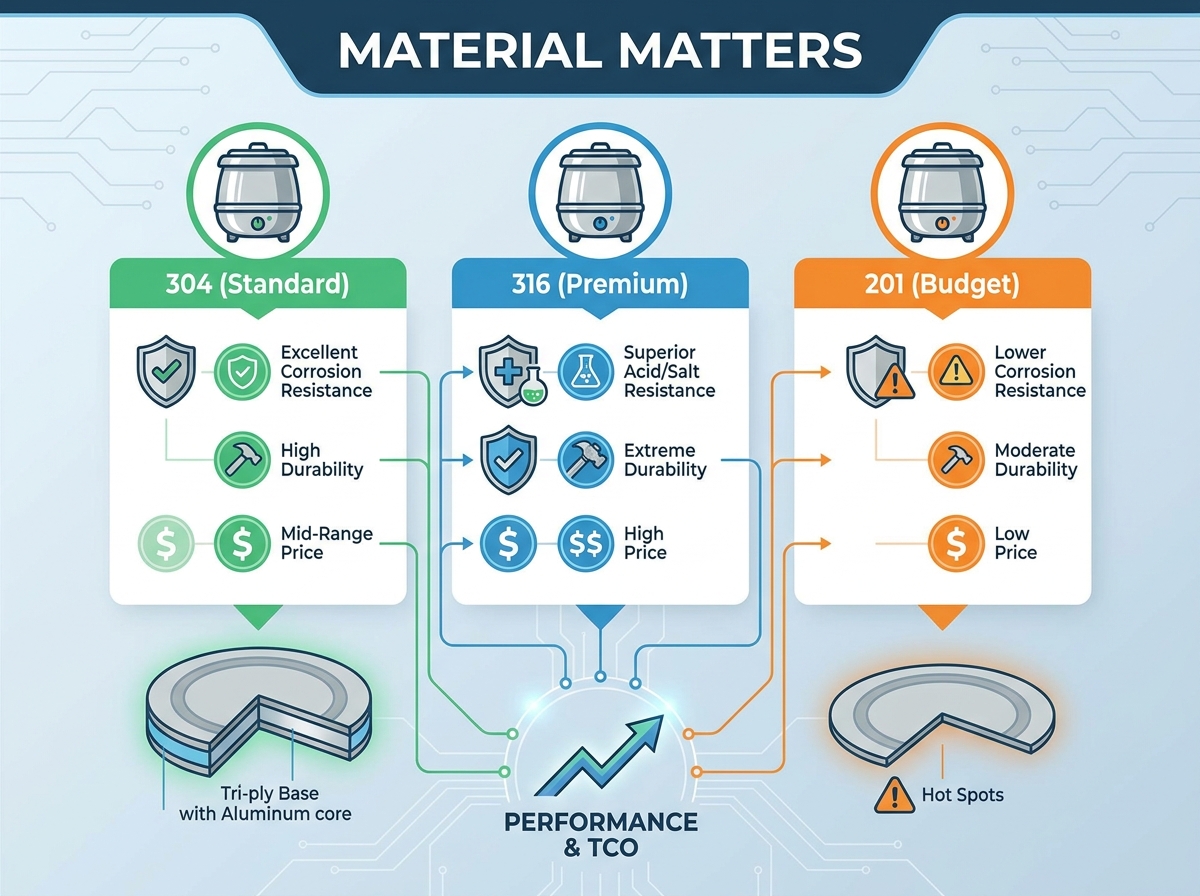
You must evaluate specific technical features before making a major purchase. The underlying materials and construction methods heavily dictate how the equipment performs.
Not all stainless alloys perform equally in harsh commercial environments. Manufacturers use specific metallurgical blends to achieve different operational goals.
Comparison of Common Stainless Steel Grades
Material Grade | Alloy Composition | Best Use Case | Durability Risk Profile |
|---|---|---|---|
304 (18/8 or 18/10) | 18% Chromium, 8-10% Nickel | General commercial use, daily simmering | Low - Industry standard for corrosion resistance |
316 | Includes added Molybdenum | High-acid, heavy salt continuous usage | Extremely Low - Premium tier performance |
201 / 400 Series | Low Nickel, High Manganese | Infrequent, light-duty utility tasks | High - Prone to pitting and early rust |
We consider 304 (often labeled 18/8 or 18/10) the absolute industry standard. It offers high durability alongside excellent corrosion resistance. It handles harsh daily washing and continuous cooking effortlessly. Grade 316 represents the premium choice. Kitchens producing high-salt or high-acid continuous batches require 316 steel. Think of heavy tomato-based sauces, citrus reductions, or heavily seasoned seafood boils. It resists chemical pitting far better than standard grades. The 201 and 400 series fall squarely into the budget tier. Manufacturers use less nickel, making the steel cheaper but highly vulnerable. It easily pits and rusts over time. We highly recommend avoiding these grades for any heavy-duty commercial applications.
A single sheet of raw steel transfers heat poorly. You absolutely need a tri-ply or encapsulated bottom. Manufacturers sandwich a thick aluminum or copper core directly between layers of exterior stainless steel. This layered construction ensures rapid, incredibly even heat distribution across the entire base. It eliminates scorching zones and allows precise temperature control during complex reductions. If your kitchen utilizes modern magnetic stoves, you must verify induction compatibility before ordering. The exterior base layer must consist of magnetic stainless steel. Without it, the induction burner will simply fail to activate.
Small details in construction deeply influence longevity and daily usability for the kitchen staff.
Handles: You will frequently encounter welded and riveted options. Heavy-duty riveted handles offer superior mechanical strength for lifting massive liquid volumes. However, rivets require extra attention during evening cleaning procedures. Bacteria can hide stubbornly around the interior rivet heads. Welded handles offer a completely smooth interior but must feature industrial-grade spot welds to prevent snapping.
Rims: Always look for reinforced, rolled edges. They provide crucial structural rigidity to prevent the pot from denting when slammed against metal sinks. Rolled edges also ensure drip-free pouring, keeping kitchen floors safe and dry.
Lids: Recessed covers sit tightly inside the metal rim. They retain moisture beautifully and promote excellent thermal looping. Flat lids often let steam escape easily, which severely reduces efficiency during long, slow reductions.
Kitchens operating at massive scale require highly specialized vessel configurations. You must match the equipment features directly to your specific service style.
Stovetop barrels offer maximum kitchen versatility. You can move them across different ranges, ovens, and washing stations effortlessly. However, they monopolize valuable main burner space during peak service hours. Electric units feature fully integrated temperature control systems. Staff can plug them in anywhere across the facility, freeing up the primary cookline. They maintain precise holding temperatures for hours without supervision. The main downside involves rigorous cleaning protocols. You cannot safely submerge electric bases in commercial wash sinks, requiring careful manual sanitation.
High-volume broth service often benefits immensely from integrated spigots. Ladling hot liquid for hundreds of individual portions wastes tremendous time. A precision valve allows staff to dispense clear liquids rapidly. Evaluate the mechanical durability of these mechanisms carefully. Cheap plastic valves break easily and can leak boiling liquid onto operators. Always opt for solid metal spigots. They must feature easily removable internal components. Kitchen staff must disassemble and sanitize the entire valve daily to prevent dangerous bacteria buildup.
Where you serve the food matters just as much as how you cook it. Single-wall kitchen-bound barrels work perfectly on active, continuous heat sources. They transfer heat efficiently from the burner to the food. Conversely, catering events and buffet lines demand double-walled configurations. These insulated units lack an active heat source. They rely entirely on their vacuum construction to trap internal heat. A good insulated vessel keeps contents at safe serving temperatures for hours. They also prevent accidental skin burns if a guest touches the exterior shell.
Understanding the current market pricing structure prevents costly purchasing mistakes. You should align your budget precisely with your anticipated usage level to maximize value.
This tier fits only very tight operational budgets. The profile typically features 201-grade steel or extremely thin-gauge 304 steel. They almost always utilize a single-layer bottom. The primary use case is light-duty, highly infrequent use. If you strictly need a vessel for mixing dry ingredients, these work fine. However, they carry an extremely high risk of scorching during active cooking. We do not recommend them for professional commercial kitchens.
This category represents the ideal sweet spot for 90% of busy restaurants and institutional kitchens. You will find robust 304 stainless steel dominates this range. They feature thick encapsulated aluminum bases and heavily reinforced handles. Most importantly, they usually carry genuine NSF certification. A high-quality Stainless Steel Soup Barrel in this tier withstands rigorous daily abuse. It balances cooking performance, physical durability, and upfront financial investment perfectly.
Intense industrial environments demand premium engineered solutions. This profile consistently includes 316 stainless or extremely thick-gauge 304 steel. They often boast full-clad construction, meaning the heat-conducting core extends completely up the sidewalls. You will regularly see integrated volume markers and precision metal dispensing spigots. The primary use case includes bulk food manufacturing and continuous high-acid reduction. High-end commercial scaling justifies this steep investment through unparalleled longevity and exact performance.
Buying heavy commercial equipment online introduces specific logistical risks. You must carefully scrutinize suppliers before authorizing any major purchase orders.
Manufacturers occasionally misrepresent actual functional volume. A stated brim capacity differs greatly from usable cooking volume. You cannot safely fill a pot to the absolute brim while boiling liquids. Always verify the actual usable capacity beforehand. Ask the supplier for exact interior dimensions. Calculate the volume yourself to ensure the vessel meets your daily batch requirements.
Heavy steel cookware easily sustains structural damage during freight transit. Dented rims make precision lids fit poorly. Warped bases completely ruin induction heat distribution. The importance of choosing suppliers with robust shipping protocols cannot be overstated. Insist heavily on palletized shipping for bulk orders. Pallets prevent lazy couriers from dropping individual boxes onto concrete floors. Inspect the delivery thoroughly immediately upon arrival before signing the final freight receipt.
B2B supplier policies vary wildly across the industry. Evaluate their explicit terms regarding weld failures, spreading rust, and thermal base warping. A highly reliable manufacturer stands proudly behind their product. They will cover structural failures resulting from normal, expected commercial use. Avoid sketchy suppliers offering limited 30-day return windows. Heavy-duty kitchen equipment requires at least a one-year commercial warranty.
Follow this simple checklist to finalize your procurement strategy securely:
Measure your commercial burner grates to ensure the base diameter fits securely without tipping.
Verify your induction equipment needs and confirm the pot features a magnetic outer base.
Calculate your absolute maximum liquid batch size to determine necessary usable capacity.
Request official material certification sheets from the supplier to prove actual steel grades.
Confirm strict NSF or FDA compliance documentation for upcoming local health inspections.
A true commercial Stainless Steel Soup Barrel acts as a vital operational asset, not a cheap disposable commodity. Your kitchen relies on durable equipment to maintain safety standards and aggressive production speed. Buyers should always prioritize a 304-grade, tri-ply base model featuring authentic NSF certification. We consider this the absolute minimum standard for true commercial viability. Upgrading your foundational cookware directly prevents wasted ingredients and frustrating service delays. Take decisive action today by requesting a detailed quote from a verified supplier. View comprehensive product catalogs to compare exact dimensions and features side-by-side. Contact a commercial kitchen specialist to guarantee you select the perfect sizing configuration for your unique operational workflow.
A: A stock pot typically features a wider diameter-to-height ratio, making it ideal for rapid evaporation and sauce reductions. A soup barrel is noticeably taller and narrower. This specific geometry minimizes the top surface area, actively limiting evaporation. It allows busy kitchens to hold large volumes of liquid at consistent temperatures over long periods without losing valuable yield.
A: It entirely depends on the base construction. Standard 304 stainless steel inherently lacks magnetic properties. To function on an induction burner, the manufacturer must bond a specific layer of magnetic 400-series steel to the outer bottom. Always check for a distinct "induction-ready" label or test the base yourself with a magnet before purchasing.
A: Never add raw, undissolved salt to cold water. Undissolved salt crystals sink immediately to the bottom. They react chemically with the steel, causing irreversible pitting and localized corrosion. Always bring liquids to a full rolling boil before adding salt. Stir vigorously to ensure the salt dissolves instantly into the hot solution.
A: Gauge directly refers to the thickness of the metal. The gauge number shares an inverse relationship with actual material thickness. A lower number means significantly thicker steel. For commercial kitchens, we highly recommend 18-gauge or lower. Thicker steel strongly resists denting, prevents structural warping, and ensures highly reliable performance under heavy daily abuse.