


Views: 0 Author: Site Editor Publish Time: 2026-10-26 Origin: Site


Turkey hunting inherently involves harsh elements. Spring rain, high humidity, and dense brush constantly batter your field gear. These relentless conditions make sudden corrosion a primary threat to standard blued steel shotguns. Hunters often find themselves fighting rust just weeks into the season.
Upgrading a shotgun for optimal turkey performance requires a highly calculated approach. You must carefully balance extreme weather resistance against pattern density and overall maneuverability. Factory barrels frequently fail when subjected to successive seasons of heavy use in wet environments. A degraded bore directly ruins pattern consistency.
This article provides a strict, specification-driven framework to help you choose the ultimate upgrade. We will evaluate how to select a custom or drop-in Stainless Steel Turkey Barrel. You will learn exactly which internal geometries, lengths, and anti-glare finishes matter most in the turkey woods.
Material Grade: 416R stainless steel is the industry standard for durability and machining precision.
Finish is Critical: Polished stainless creates glare that spooks birds; a matte, bead-blasted, or Cerakoted finish is mandatory.
Length Dynamics: 20- to 24-inch barrels offer the best balance of blind maneuverability without sacrificing pattern performance.
Internal Geometry: Extended forcing cones and modern choke thread compatibility dictate payload delivery more than overall barrel length.
Gauge Trends: The rise of Tungsten Super Shot (TSS) has made 20-gauge stainless barrels highly viable alternatives to traditional 12-gauge setups.
Hunting spring gobblers often means sitting against damp oaks or hiking through rain-soaked creek bottoms. Factory carbon steel barrels rely heavily on thin blued finishes to repel moisture. This traditional finish offers minimal protection against the wet spring conditions hunters face. Water inevitably finds microscopic scratches in the bluing. Once moisture penetrates, pitting and rust develop rapidly inside the bore and around the choke threads.
Stainless steel fundamentally changes this vulnerability. The high chromium content within the alloy creates a passive oxide layer. This chemical barrier prevents rust from taking hold. Hunters who upgrade spend less time scrubbing surface rust and more time focusing on the hunt. The durability gap between standard carbon steel and high-grade stainless becomes aggressively apparent after a single wet season.
We must also address a common performance reality check. A stainless barrel does not inherently tighten pellet patterns on its own. The primary bottom-of-the-funnel value lies in maintaining internal bore integrity over time. A pitted carbon steel bore deforms lead and copper pellets. It also leads to seized choke tubes. Stainless steel maintains a pristine internal surface. This ensures consistent choke seating and uniform payload delivery year after year.
Evaluating the cost-to-lifespan ratio justifies the upgrade. Premium aftermarket barrels demand a higher upfront cost. However, you frame this purchase as a long-term investment in reliability. Standard barrels require frequent oiling, rigorous cleaning, and eventual replacement once rust compromises the threads. A well-machined stainless upgrade eliminates these recurring maintenance headaches entirely.
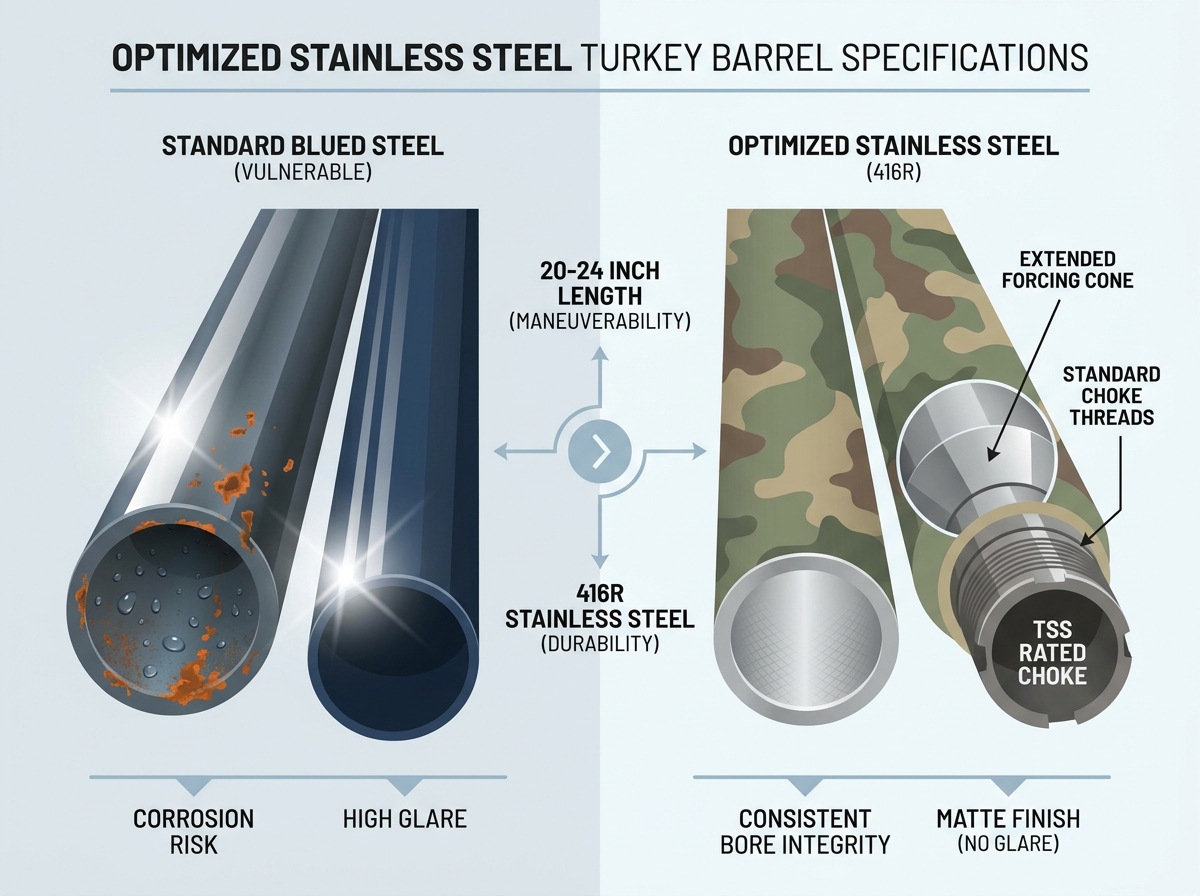
Many hunters still fall victim to the "long barrel" myth. Online forums often debate the necessity of 28-inch or 30-inch barrels for reaching out to distant gobblers. We need to thoroughly debunk this outdated concept. Extended barrel lengths were historically necessary to burn slow, older powders fully. Today, modern turkey load powders burn entirely within the first 18 to 20 inches of the barrel.
Excessive length offers zero velocity advantages for contemporary turkey ammunition. Instead, long barrels act as massive liabilities in the woods. They catch on low-hanging vines during stalks. They also bump against ground blind fabric, instantly spooking approaching birds. An optimal length range falls strictly between 20 and 24 inches.
Ground blind operations heavily favor shorter barrels. You need the ability to shift your shooting angle quietly. A 20-inch barrel allows you to track a moving bird without snagging the window mesh. Furthermore, weight distribution vastly improves. Shorter, thicker-contoured stainless profiles keep the shotgun's center of gravity squarely between your hands. This balance promotes faster, smoother shouldering when a gobbler appears suddenly.
You must acknowledge sight radius considerations when shortening your setup. A 20-inch barrel significantly reduces the traditional bead sight radius. This shorter distance can magnify tiny aiming errors. Therefore, integrating an optic becomes a necessary specification. A drilled and tapped receiver or a cantilever optics mount resolves this issue. Red dot sights eliminate the need for a long sighting plane, making short barrels incredibly lethal.
Choosing the correct chambering dictates your entire turkey hunting strategy. The debate between 12-gauge and 20-gauge has evolved dramatically over the last decade. You must evaluate payload capacity, perceived recoil, and ammunition availability.
Standard 12-gauge specifications typically involve 3-inch and 3.5-inch chambers. These massive chambers offer unparalleled payload capacity. They remain highly recommended for hunters utilizing traditional lead or standard copper-plated turkey loads. However, you must evaluate this capacity against excessive recoil. A 3.5-inch magnum turkey load generates punishing kickback. This recoil often induces flinching, which pulls the muzzle off target during the critical trigger press.
Conversely, 20-gauge specifications typically center on a 3-inch chamber. The industry has witnessed a massive shift toward these sub-gauges. Tungsten Super Shot (TSS) completely drives this modern trend. TSS pellets are significantly denser than lead. This density allows a 20-gauge to deliver devastating pattern density at 40 yards and beyond.
You must evaluate the weight reduction benefits of a 20-gauge platform. A lighter receiver paired with a 20-inch barrel creates an incredibly maneuverable system. Hunters experience far less arm fatigue during long, aggressive stalks. Regardless of the gauge you select, chamber tolerance remains vital. You should look for precisely machined chambers. Tight tolerances prevent frustrating extraction failures when firing high-brass, high-pressure turkey loads.
Gauge Performance Dynamics Comparison
Feature Specification | 12-Gauge (3" and 3.5" Chambers) | 20-Gauge (3" Chamber) |
|---|---|---|
Primary Ammunition Use | Traditional Lead, Copper-Plated, TSS | Optimized primarily for TSS |
Recoil Profile | Heavy to Severe (especially 3.5") | Mild to Moderate |
Maneuverability & Weight | Heavier, slower handling in dense brush | Lightweight, highly maneuverable |
Effective Range (with TSS) | 60+ Yards (Extreme Payload) | 50-60 Yards (Highly efficient) |
Focusing purely on exterior dimensions ignores the most critical aspect of barrel performance. Internal geometry dictates payload delivery far more than overall length. The journey of the wad and pellets through the bore determines your final pattern density. You must pay close attention to the forcing cone specifications.
The forcing cone acts as the bridge between the chamber and the main bore. Factory barrels usually feature short, abrupt forcing cones. When heavy turkey payloads hit this steep angle, pellets crush against each other. Deformed pellets fly erratically and leave the main pattern core. Lengthened or polished forcing cones in custom barrels provide a gentle, elongated taper. This gradual transition significantly reduces pellet deformation and noticeably softens perceived recoil.
Bore diameter also requires careful evaluation. You will encounter standard profiles and over-bored, or back-bored, profiles. Back-boring increases the internal diameter slightly above standard specifications. This wider bore reduces friction and often improves patterns with traditional lead shot. However, you must exercise caution with heavy turkey payloads.
Overly aggressive back-boring can cause severe wad-seal issues, particularly in sub-freezing spring temperatures. Cold weather makes plastic wads stiff and inflexible. If the bore is too wide, the stiff wad fails to seal expanding gases. Gas blow-by reduces velocity and blows holes through the center of your pattern.
Choke thread systems represent the final internal hurdle. You must specify the necessity for industry-standard threads. Opt for widely supported systems like Rem Choke, Invector-Plus, or Mobil. Standardized threads ensure flawless compatibility with high-end aftermarket specialized turkey chokes. Furthermore, you must assess the machining quality of the thread pitch. Poorly cut threads allow gas blow-by and eventually cause the choke tube to seize permanently.
Not all stainless steel performs equally in firearm manufacturing. Alloy selection heavily influences both longevity and internal precision. You must distinguish carefully between 410 and 416R stainless alloys. Factory mass-produced barrels often utilize 410 stainless. It provides decent corrosion resistance but lacks optimal machinability.
High-end manufacturers overwhelmingly prefer 416R stainless. We highlight 416R for its vastly superior machinability. Tooling cuts this specific alloy cleaner, leaving a mirror-like finish inside the bore. This precise cutting ability leads to much tighter bore tolerances. Better tolerances directly translate to reliable, repeatable patterns when shooting premium TSS ammunition.
Despite its durability, bare stainless introduces a fatal flaw into the turkey woods. The glare problem cannot be overstated. Wild turkeys possess exceptional eyesight. They detect ultraviolet light and spot unnatural reflections from hundreds of yards away. Carrying a bright, polished barrel practically guarantees you will spook birds before they step into range.
Required surface treatments mitigate this critical issue. You cannot skip this step. Bead blasting achieves a dull, matte gray finish. It breaks up the reflective surface of the steel effectively. However, bead blasting still leaves a distinctly metallic look.
Cerakote application represents the ultimate concealment strategy. Manufacturers use the stainless steel as a rust-proof base layer. They then apply a matte camo or flat dark earth (FDE) ceramic coating over it. This combination delivers absolute visual concealment while providing double-layered protection against the harshest spring storms.
Selecting the right upgrade involves navigating a complex market. You must understand how to specify the correct fit and verify manufacturing quality. The buying process generally splits into two categories: factory drop-in replacements and custom gunsmith-fitted builds.
We must determine if a barrel is true "plug-and-play." Many mass-produced pump shotguns accommodate drop-in barrels effortlessly. Popular receivers handle swapping easily. However, manufacturing tolerances vary wildly. A barrel might slide into the receiver but fail to lock up securely. Custom builds almost always require professional headspace checking. A gunsmith ensures the breech bolt locks safely against the new chamber.
You need a structured approach to shortlisting your options. Follow these sequential steps when finalizing your purchase:
Verify Receiver Compatibility: Confirm the exact make, model, and generation of your shotgun receiver before ordering.
Select Choke Thread Standard: Ensure the barrel utilizes a universal thread pitch to allow access to premium aftermarket chokes.
Confirm Finish Type: Explicitly order a bead-blasted or Cerakoted finish; reject any polished options.
Check Concentricity Guarantees: Ask the manufacturer if they guarantee bore concentricity to ensure your point-of-aim matches your point-of-impact.
Manufacturer warranties and tolerances separate premium makers from budget options. Look strictly for guarantees on bore concentricity. A barrel bored slightly off-center will shoot left or right of the bead. Concentricity guarantees ensure your heavy turkey loads strike exactly where you aim.
Finally, you must factor in lead times. Custom barrel makers frequently discuss their backlog in niche hunting forums. You should expect 3 to 6 month turnaround times. If you want a specialized 20-inch, 416R barrel coated in FDE Cerakote, you must place your order long before spring turkey season begins.
Upgrading your shotgun demands careful attention to precise specifications. The best turkey barrel securely combines a 20- to 24-inch length, a dull matte finish, and standard choke threading. This specific combination guarantees superior blind maneuverability while completely eliminating the threat of moisture-induced rust.
We advise buyers to continually prioritize internal geometry and optic-mounting capabilities over maximum overall length. Lengthened forcing cones and tight bore tolerances dictate pattern density far more than an extra four inches of steel. A shorter setup paired with a drilled and tapped receiver creates the ultimate modern turkey hunting platform.
Your next action is immediate. Check your current receiver compatibility today. Inspect your factory setup for rust or worn threads. Then, begin sourcing a dedicated replacement with your preferred choke thread system to ensure absolute readiness for the spring woods.
A: Yes, if the metal is highly polished. Turkeys possess incredible eyesight and easily detect unnatural glare. Buyers must specifically request a bead-blasted matte finish. Alternatively, you can apply a Cerakote treatment or a camo wrap to eliminate all reflections entirely.
A: Yes, modern stainless steel easily handles the extreme pressures generated by TSS loads. However, the critical factor lies at the muzzle. You must ensure your choke tube is explicitly TSS-rated, as tungsten is much harder than standard steel.
A: No. Modern turkey loads achieve complete powder burn within 18 to 20 inches. A shorter barrel slightly compromises your traditional sight radius, not lethality. Utilizing a red dot optic completely resolves the sight radius issue.
A: Most mass-market pump and semi-auto shotgun barrels are designed as drop-in ready. However, custom-machined options may require minor gunsmith fitting. A professional ensures proper lock-up and verifies headspace for safe operation.